Volume 6, Issue 3 (Vol6,No3(21) 2025)
2025, 6(3): 510-527 |
Back to browse issues page



Ethics code: کد اخلاق ندارد


Download citation:
BibTeX | RIS | EndNote | Medlars | ProCite | Reference Manager | RefWorks
Send citation to:


BibTeX | RIS | EndNote | Medlars | ProCite | Reference Manager | RefWorks
Send citation to:
Bana Z, Oladiyan M, Safari M. (2025). Designing a Student Researcher Model for Learning Skills Based on the KHANA Plan in Iranian Primary Schools. Journal of Childhood Health and Education. 6(3), 510-527. doi:10.32598/JECHE.6.3.375.1
URL: http://jeche.ir/article-1-342-en.html
URL: http://jeche.ir/article-1-342-en.html

1- Department of Educational Sciences, Dmv.C. Islamic Azad University, Damavand, Iran.
Full-Text [PDF 8136 kb]
(346 Downloads)
| Abstract (HTML) (1321 Views)
Full-Text: (161 Views)
Introduction
Research-based learning is an educational approach that emphasizes research, investigation, and problem-solving. It is different from other traditional approaches because it is a form of reverse learning. Instead of providing information or answers, teachers begin by presenting a wide range of scenarios, questions, and issues for students to investigate and research. A student researcher is a student who conducts research on learning, individually or in collaboration with other students, to improve educational effectiveness; i.e., the fulfillment of their own academic milestones. One of the appropriate measures of the Education Department in Iran is the development of plans to train student researchers. One of these plans is named KHANA in Persian (Reading, writing, life skills). The goal of this plan is to improve the four language and life skills of primary school students (preschool and elementary school). This plan significantly supports teachers' teaching goals in primary schools. In fact, teachers are obliged to comply with all clauses of this plan in order to anticipate all existing activities.
The present study is an attempt to identify the dimensions of the student-researcher model for learning the KHANA-based skills in primary schools. The research questions are: What model can be presented to train student researchers to learn the KHANA-based skills in the primary school? What is the priority of the dimensions of the student-researcher model for learning the KHANA-based skills in the primary school? What is the status of the dimensions of the student-researcher model for learning the KHANA-based skills in the primary school? How valid is the proposed student-researcher model?
Research Methods
This is a mixed-method (qualitative-quantitative) exploratory study. The study population in the qualitative phase included professors from Farhangian University and the University of Tehran in 2021-2022. Of these, 12 participants were selected through purposive sampling and based on the principle of theoretical saturation. In this phase, semi-structured interviews were used to collect data. The content was analyzed with an inductive approach. The study population in the quantitative phase included all principals, deputy principals, and teachers of primary schools in Tehran, Iran (n=1125), who had experience in the field of teaching student researchers. Of these, 286 participants were selected. In this phase, a researcher-made questionnaire was used to collect data, which was designed based on the components identified in the qualitative phase. It had 78 items and 3 dimensions: model structure (knowledge, skill, attitude), model feature (Student-related, supports, teaching-related), and model goal (focus-oriented, participation-oriented, problem-oriented). The items were rated on a five-point Likert scale. It had a content validity of 0.70, which is acceptable based on the Lawshe table. Reliability was also confirmed with Cronbach's alpha and composite reliability coefficients >0.7. In this phase, the data were analyzed in SPSS software, version 23. The data had a normal distribution based on the Kolmogorov-Smirnov test results (P>0.05). The prioritization of identified components was done using the AHP method.
Results
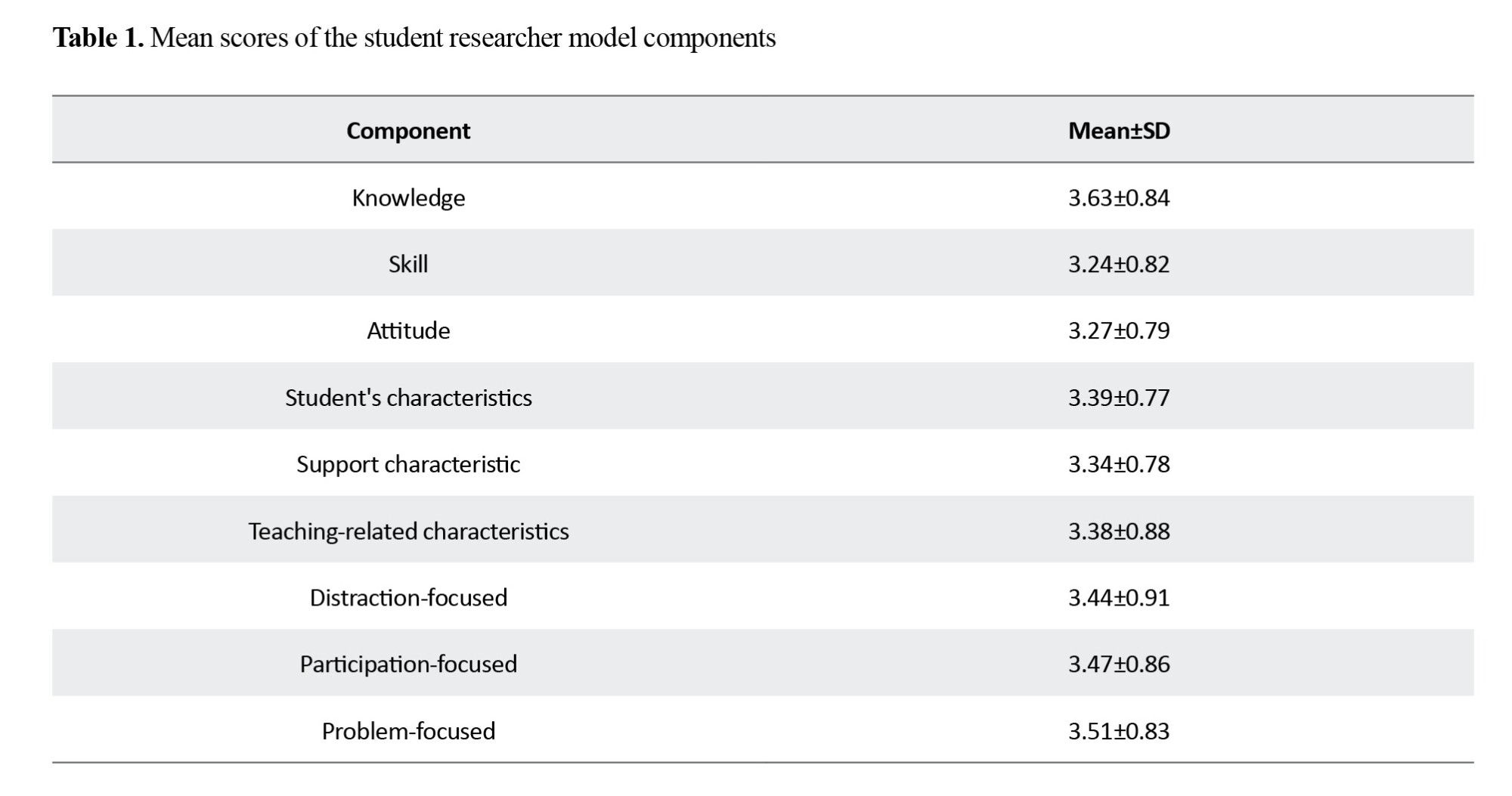
Among the 12 professors in the qualitative phase, 3 were in the field of educational management, 5 in educational research, and 4 in curriculum planning. They included 8 males and 4 females. In the quantitative phase, of 286 participants, 109 were female, and 177 were male. The mean scores of the students are presented in Table 1.
Based on the AHP technique, the model structure with a weight of 0.412 was given first priority; the model feature with a weight of 0.309 was given second priority, and the model goal with a weight of 0.279 was given third priority. Among the components of the structure dimension, the problem-focused (0.437), participation-focused (0.306), and distraction-focused structures (0.257) were ranked first, second, and third, respectively. Regarding the components of the feature dimension, the teaching-related characteristic with a weight of 0.499 was given first priority; the supportive characteristic with a weight of 0.298 was given second priority, and the student's characteristic with a weight of 0.204 was given third priority. Regarding the components of the goal dimension, knowledge with a weight of 0.459 was ranked first; attitude with a weight of 0.342 was ranked second; and skill with a weight of 0.199 was ranked third. The t-test results showed a P<0.05. Based on the positive mean difference values, the status of the dimensions and components of the student researcher model was slightly above average.
Conclusion
The proposed student researcher model had 3 domains and 9 components (Knowledge, skill, attitude, student's characteristics, support characteristic, teaching-related characteristics, distraction-focused goal, participation-focused goal, and problem-focused goal). The roles of knowledge, skills, and attitudes in encouraging students to conduct research are vital. According to the findings, it is recommended to provide training in effective questioning techniques for primary school teachers in order to develop their professional skills. Additionally, primary school principals should encourage teachers to model questioning behaviors and to create stimulus-based learning programs that elicit student responses.
Ethical Considerations
Compliance with ethical guidelines
All ethical principals were considered in this study, including informed consent of participants and the confidentiality of their information.
Funding
This article was extracted from a dissertation approved by Islamic Azad University, Damavand Branch (Code: 36910). This research did not receive any specific grant from funding agencies in the public, commercial, or not-for profit sectors.
Authors contributions
Data collection and writing: Zahra Bana; data analysis, editing & review: Masoumeh Oladian and Mahmoud Safari.
Conflicts of interest
The authors declare no conflict of interest.
Acknowledgments
The authors would like to thank all participants for their cooperation.
Research-based learning is an educational approach that emphasizes research, investigation, and problem-solving. It is different from other traditional approaches because it is a form of reverse learning. Instead of providing information or answers, teachers begin by presenting a wide range of scenarios, questions, and issues for students to investigate and research. A student researcher is a student who conducts research on learning, individually or in collaboration with other students, to improve educational effectiveness; i.e., the fulfillment of their own academic milestones. One of the appropriate measures of the Education Department in Iran is the development of plans to train student researchers. One of these plans is named KHANA in Persian (Reading, writing, life skills). The goal of this plan is to improve the four language and life skills of primary school students (preschool and elementary school). This plan significantly supports teachers' teaching goals in primary schools. In fact, teachers are obliged to comply with all clauses of this plan in order to anticipate all existing activities.
The present study is an attempt to identify the dimensions of the student-researcher model for learning the KHANA-based skills in primary schools. The research questions are: What model can be presented to train student researchers to learn the KHANA-based skills in the primary school? What is the priority of the dimensions of the student-researcher model for learning the KHANA-based skills in the primary school? What is the status of the dimensions of the student-researcher model for learning the KHANA-based skills in the primary school? How valid is the proposed student-researcher model?
Research Methods
This is a mixed-method (qualitative-quantitative) exploratory study. The study population in the qualitative phase included professors from Farhangian University and the University of Tehran in 2021-2022. Of these, 12 participants were selected through purposive sampling and based on the principle of theoretical saturation. In this phase, semi-structured interviews were used to collect data. The content was analyzed with an inductive approach. The study population in the quantitative phase included all principals, deputy principals, and teachers of primary schools in Tehran, Iran (n=1125), who had experience in the field of teaching student researchers. Of these, 286 participants were selected. In this phase, a researcher-made questionnaire was used to collect data, which was designed based on the components identified in the qualitative phase. It had 78 items and 3 dimensions: model structure (knowledge, skill, attitude), model feature (Student-related, supports, teaching-related), and model goal (focus-oriented, participation-oriented, problem-oriented). The items were rated on a five-point Likert scale. It had a content validity of 0.70, which is acceptable based on the Lawshe table. Reliability was also confirmed with Cronbach's alpha and composite reliability coefficients >0.7. In this phase, the data were analyzed in SPSS software, version 23. The data had a normal distribution based on the Kolmogorov-Smirnov test results (P>0.05). The prioritization of identified components was done using the AHP method.
Results
Among the 12 professors in the qualitative phase, 3 were in the field of educational management, 5 in educational research, and 4 in curriculum planning. They included 8 males and 4 females. In the quantitative phase, of 286 participants, 109 were female, and 177 were male. The mean scores of the students are presented in Table 1.
Based on the AHP technique, the model structure with a weight of 0.412 was given first priority; the model feature with a weight of 0.309 was given second priority, and the model goal with a weight of 0.279 was given third priority. Among the components of the structure dimension, the problem-focused (0.437), participation-focused (0.306), and distraction-focused structures (0.257) were ranked first, second, and third, respectively. Regarding the components of the feature dimension, the teaching-related characteristic with a weight of 0.499 was given first priority; the supportive characteristic with a weight of 0.298 was given second priority, and the student's characteristic with a weight of 0.204 was given third priority. Regarding the components of the goal dimension, knowledge with a weight of 0.459 was ranked first; attitude with a weight of 0.342 was ranked second; and skill with a weight of 0.199 was ranked third. The t-test results showed a P<0.05. Based on the positive mean difference values, the status of the dimensions and components of the student researcher model was slightly above average.
Conclusion
The proposed student researcher model had 3 domains and 9 components (Knowledge, skill, attitude, student's characteristics, support characteristic, teaching-related characteristics, distraction-focused goal, participation-focused goal, and problem-focused goal). The roles of knowledge, skills, and attitudes in encouraging students to conduct research are vital. According to the findings, it is recommended to provide training in effective questioning techniques for primary school teachers in order to develop their professional skills. Additionally, primary school principals should encourage teachers to model questioning behaviors and to create stimulus-based learning programs that elicit student responses.
Ethical Considerations
Compliance with ethical guidelines
All ethical principals were considered in this study, including informed consent of participants and the confidentiality of their information.
Funding
This article was extracted from a dissertation approved by Islamic Azad University, Damavand Branch (Code: 36910). This research did not receive any specific grant from funding agencies in the public, commercial, or not-for profit sectors.
Authors contributions
Data collection and writing: Zahra Bana; data analysis, editing & review: Masoumeh Oladian and Mahmoud Safari.
Conflicts of interest
The authors declare no conflict of interest.
Acknowledgments
The authors would like to thank all participants for their cooperation.
Reference
Abraham, L. (2016). Inculcation of research Spirit in Students. International Journal of Scientific Research and Modern Education. [Link]
Akbari, M., Heydarian, M., & Mozaffari, S. (2022). [The effectiveness of verbal self-instruction on social competence and self-esteem of students with specific learning disorder in Sanandaj (Persian)]. Journal of Childhood Health and Education, 2(4), 79-96. [Link]
Attride-Stirling, J. (2001). Thematic networks: An analytic tool for qualitative research. Qualitative Research, 1(3), 385-405. [DOI:10.1177/146879410100100307]
Belali Kharaji, T. (2021). [Analyzing research-based learning and promoting students’ research spirit (Persian)]. Paper presented at: National Conference on Professional Research in Psychology and Counseling with a Teacher’s Perspective, Minab, Iran, 9 April 2021. [Link]
Boesdorfer, S. B., Anderson, S. M., Botello, J. A., Webb, K. E., Mowery, D., & Daughety, B. M., et al. (2023). Experiences with flipped classroom methodology in US high school chemistry courses: Lessons learned from action research projects. Journal of Chemical Education, 100(6), 2096-2104. [Link]
Chaudhry, S., Tandon, A., Shinde, S., & Bhattacharya, A. (2024). Student psychological well-being in higher education: The role of internal team environment, institutional, friends and family support and academic engagement. Plos One, 19(1), e0297508. [DOI:10.1371/journal.pone.0297508] [PMID]
Dabaran, M. R. (2021). What is the Khanaa Plan? Jaber Plan.
DeVito, M. (2016). Factors Influencing Student Engagement. [ Certificate of Advanced Study Thesis]. Connecticut: Sacred Heart University. [Link]
Ferguson, T., & Ellis, T. (2022). Developing master’s level education students as researchers: Mentors’ and mentees’ experiences. Mentoring & Tutoring: Partnership in Learning, 30(2), 235-255. [DOI:10.1080/13611267.2022.2057099]
Forozanmehr, M., Aliesmaeili, A., & Ghasemzadeh, K. (2025). [Presenting a Technological Learning Model in Iranian Schools Focused on the Emerging Technology of Metaverse (Persian)]. Journal of Early Childhood Health and Education, 6(1), 1-20.[Link]
Hawizaei, Z. (2022). The impact of motivation and inspiration on student learning. New Advances in Psychology, Educational Sciences, and Education, 57,16-81.
Hollingsworth, H. L., & Vandermaas-Peeler, M. (2017). ‘Almost everything we do includes inquiry’: Fostering inquiry-based teaching and learning with preschool teachers. Early Child Development and Care, 187(1):152-167. [DOI:10.1080/03004430.2016.1154049]
Kamjoo, S. (2019). Who is a Research Student? Retrieved from: [Link]
Levy, I. P., Edirmanasinghe, N., Ieva, K., & Hilliard, C. (2023). Youth participatory action research as school counseling praxis: A scoping review. Professional School Counseling, 27(1a).[DOI:10.1177/2156759X231153347]
Ramezani, B. (2023). Studying the effectiveness of implementing the Khuna project on improving learning skills in Persian lessons (reading, writing and speaking) for elementary school students in Kermanshah. Paper presented at: International Conference of Humanities, Educational Sciences, Law and Social Sciences, İzmir, Turkey, 17 April 2023. [Link]
Ranjbari, E., Ranjbari, E., & Afrashte, H. (2021). [The effect of the legible plan on the academic progress and self-efficacy of elementary school students in Bandar Abbas city (Persian)]. Paper presented at: National Conference on Professional Research in Psychology and Counseling with a Teacher’s Perspective, Minab, Iran, 9 April 2021. [Link]
Sandoval, M., & Messiou, K. (2022). Students as researchers for promoting school improvement and inclusion: A review of studies. International Journal of Inclusive Education, 26(8), 780-795. [DOI:10.1080/13603116.2020.1730456]
Tholibon, D. A., Nujid, M. M., Mokhtar, H., Rahim, J. A., Rashid, S. S., & Saadon, A., et al. (2022). The factors of students’ involvement on student-centered learning method. International Journal of Evaluation and Research in Education, 11(4), 1637-1646. [DOI:10.11591/ijere.v11i4.22314]
Werder, C., & Otis, M. M. (2023). Engaging student voices in the study of teaching and learning. Oxfordshire: Taylor & Francis. [Link]
Yang, D., Cai, Z., Wang, C., Zhang, C., Chen, P., & Huang, R. (2023). Not all engaged students are alike: patterns of engagement and burnout among elementary students using a person-centered approach. BMC Psychology, 11(1), 38. [DOI:10.1186/s40359-023-01071-z] [PMID]
Type of Study: Research |
Subject:
General
Received: 2025/05/19 | Accepted: 2025/10/7 | Published: 2025/12/16
Received: 2025/05/19 | Accepted: 2025/10/7 | Published: 2025/12/16
Send email to the article author
| Rights and permissions | |
 |
This work is licensed under a Creative Commons Attribution-NonCommercial 4.0 International License. |