Volume 6, Issue 3 (Vol6,No3(21) 2025)
2025, 6(3): 480-491 |
Back to browse issues page



Ethics code: IR.IAU.SRB.REC.1404.054


Download citation:
BibTeX | RIS | EndNote | Medlars | ProCite | Reference Manager | RefWorks
Send citation to:


BibTeX | RIS | EndNote | Medlars | ProCite | Reference Manager | RefWorks
Send citation to:
Maleki M, Karimzadeh M, GhorbanJahromi R, Amiri M. (2025). Effectiveness of an Artistic Thinking Educational Theatre on the Aesthetic Thinking of Elementary School Girls. Journal of Childhood Health and Education. 6(3), 480-491. doi:10.32598/JECHE.6.3.382.2
URL: http://jeche.ir/article-1-355-en.html
URL: http://jeche.ir/article-1-355-en.html

1- Department of Psychology, SR.C., Islamic Azad University, Tehran, Iran.
2- Department of Preschool Education, Faculty of Behavioral Sciences and Mental Health, University of Social Welfare and Rehabilitation Sciences, Tehran, Iran.
3- Department of Psychology, SR.C., Islamic Azad University,Tehran,Iran.
4- Department of Psychology, Faculty of Humanities Sciences, Zanjan University, Zanjan, Iran.
2- Department of Preschool Education, Faculty of Behavioral Sciences and Mental Health, University of Social Welfare and Rehabilitation Sciences, Tehran, Iran.
3- Department of Psychology, SR.C., Islamic Azad University,Tehran,Iran.
4- Department of Psychology, Faculty of Humanities Sciences, Zanjan University, Zanjan, Iran.
Full-Text [PDF 5905 kb]
(355 Downloads)
| Abstract (HTML) (1474 Views)
Full-Text: (220 Views)
Introduction
Education, as a dynamic and continuous process, requires the use of new and effective methods to improve students’ cognitive and psychological capabilities. In the meantime, the development of aesthetic thinking skills has gained particular importance. Aesthetic thinking goes beyond the mere enjoyment of beauty and includes the ability to understand, interpret, and judge various aesthetic elements of works of art and everyday life experiences. This skill plays an important role in personal growth, enhancing creativity, developing cultural understanding, and creating empathy and a positive attitude towards cultural diversity. Aesthetic thinking not only helps students become more sensitive to the aesthetic aspects of art and their surroundings, but also creates greater motivation for learning and active participation in educational activities.
Developing higher-level thinking skills in students requires a diverse and multifaceted educational approach that can take into account the different abilities of students. Gardner’s theory of multiple intelligences is based on the principle that human intelligence is not a single ability but a collection of independent and distinct intelligences, including artistic, visual-spatial, linguistic, and interpersonal intelligences, with each student having a unique combination of these intelligences.
Considering the special role of aesthetic thinking in children’s cognitive and personality development and considering the limitations and gaps in the Iran’s art education system, the present study was designed to develop an artistic thinking educational program (theater) with an emphasis on developing aesthetic skills in elementary school girls.
Research Methods
This is a quasi-experimental study with a pretest/posttest/one-month follow-up design. The study population included all female students from the second-year elementary schools (grades 4-6) in Tehran, Iran, in the 2024-2025 school year. Among them, 24 were selected and randomly divided into two groups of 12, including control and intervention. The data collection tool was the Aesthetic Intelligence Questionnaire with 18 items and three domains of Sensory/literary, Mental/emotional, and Movements. It was designed by Rashid et al. in 2017. They reported a Cronbach’s alpha value of 0.81 for the entire questionnaire and 0.74, 0.72, and 0.65 for three dimensions, respectively.
The artistic thinking educational program (Educational Theater) was developed based on the theoretical framework of Goodman’s Project Zero (1967) and Gardner’s theory of multiple intelligences (1983). Ten educational sessions were held weekly, each for 90 minutes, in person for the intervention group. Data analysis was performed using repeated measures analysis of variance (ANOVA) in SPSS software, version 26. The results of the Shapiro-Wilk test (P>0.05) showed that the data had a normal distribution. Also, Levene’s test result indicated the equality of variances (P>0.05).
Results
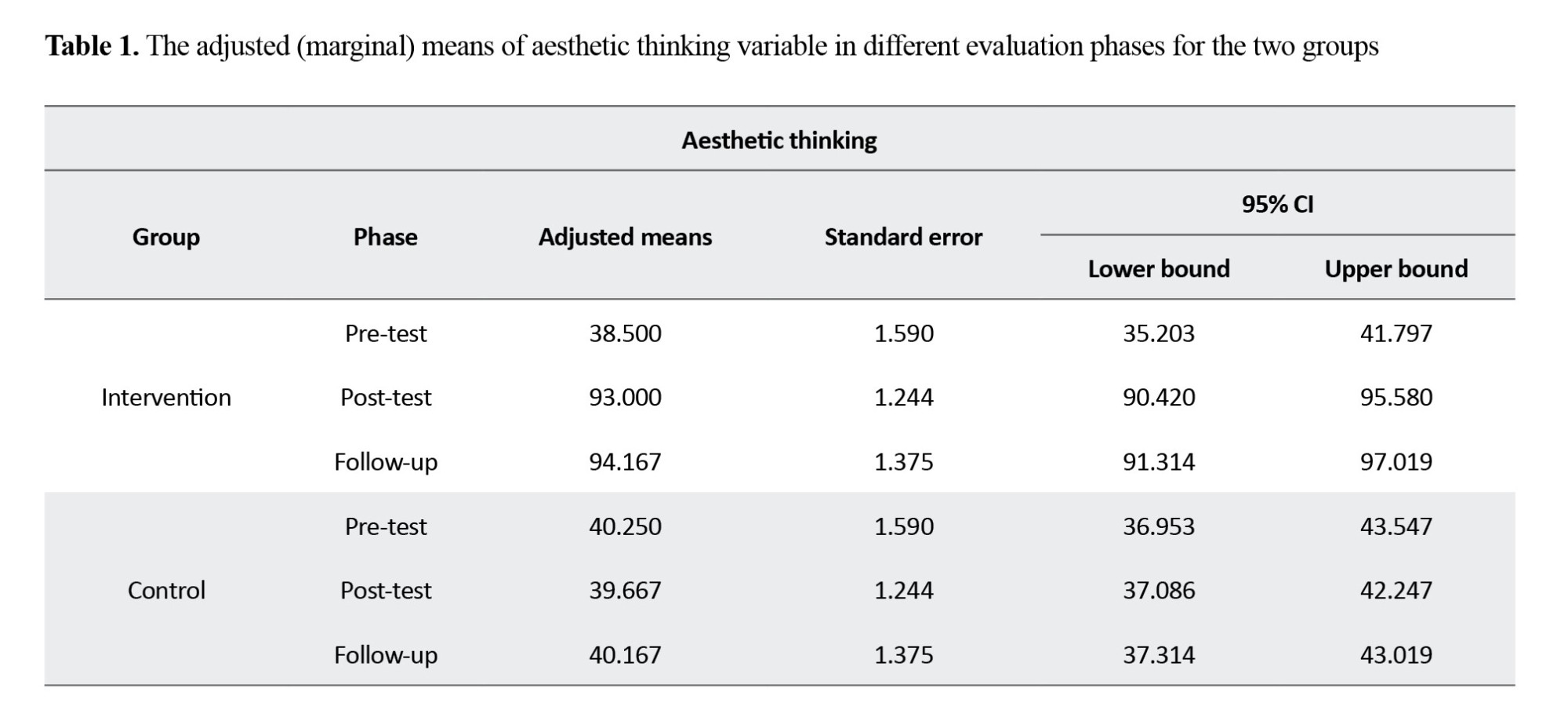
In the intervention group, 3 students (25%) were 11 years old, 5 students (41.7%) were 12 years old, and 4 students (33.3%) were 13 years old. In the control group, 3 students (25%) were 11 years old, 4 students (33.3%) were 12 years old, and 5 students (41.7%) were 13 years old. Table 1 shows the adjusted (marginal) means of aesthetic thinking variable in different stages (pretest, posttest, and follow-up) for the two groups. The ANOVA results showed that the effect of time (F=400.323, P=0.001, effect size=0.93) and the interaction effect of group × time (F=409.892, P=0.001, effect size=0.90) on students’ aesthetic thinking. The results of the Bonferroni test showed no significant difference between the post-test and follow-up scores of aesthetic thinking (P=0.178). Therefore, the effect of artistic thinking intervention on the students’ aesthetic thinking was maintained for one month (Table 1).
Conclusion
Based on the results, teaching aesthetic thinking through the artistic thinking educational theater has been able to significantly improve the aesthetic skills of elementary school girls. Therefore, using active and creative methods such as theater, which is a combination of different arts, allows to develop an aesthetic understanding, artistic interpretation, and creativity in school girls. Theatre allows them to experience the beauty of art. Stage design, costumes, music, and acting are all aesthetic elements that students can understand and enjoy. This experience helps to enhance their aesthetic sense. In an educational theater, students are not only consumers of art, but also become its creators. Theater fosters empathy and emotional understanding; it allows students to put themselves in the shoes of others and understand their feelings and experiences. This empathy can lead to enhanced critical thinking, as students are better able to understand and judge different perspectives.
Ethical Considerations
Compliance with ethical guidelines
This study has an ethical approval code (IR.IAU.SRB.REC.1404.35) obtained from Islamic Azad University, Science and Research Branch, Tehran, Iran.
Funding
This article was extracted from the dissertation of Mahbobeh Maleki at the Faculty of Humanities and Social Sciences, Islamic Azad University, Science and Research Branch, Tehran, Iran. This research did not receive any specific grant from funding agencies in the public, commercial, or not-for profit sectors.
Authors contributions
All authors contributed equally to the conception and design of the study, data collection and analysis, interpretation of the results, and drafting of the manuscript. Each author approved the final version of the manuscript for submission.
Conflicts of interest
The authors declared no conflicts of interest.
Acknowledgments
The authors would like to thank all participants for their cooperation in this study.
Education, as a dynamic and continuous process, requires the use of new and effective methods to improve students’ cognitive and psychological capabilities. In the meantime, the development of aesthetic thinking skills has gained particular importance. Aesthetic thinking goes beyond the mere enjoyment of beauty and includes the ability to understand, interpret, and judge various aesthetic elements of works of art and everyday life experiences. This skill plays an important role in personal growth, enhancing creativity, developing cultural understanding, and creating empathy and a positive attitude towards cultural diversity. Aesthetic thinking not only helps students become more sensitive to the aesthetic aspects of art and their surroundings, but also creates greater motivation for learning and active participation in educational activities.
Developing higher-level thinking skills in students requires a diverse and multifaceted educational approach that can take into account the different abilities of students. Gardner’s theory of multiple intelligences is based on the principle that human intelligence is not a single ability but a collection of independent and distinct intelligences, including artistic, visual-spatial, linguistic, and interpersonal intelligences, with each student having a unique combination of these intelligences.
Considering the special role of aesthetic thinking in children’s cognitive and personality development and considering the limitations and gaps in the Iran’s art education system, the present study was designed to develop an artistic thinking educational program (theater) with an emphasis on developing aesthetic skills in elementary school girls.
Research Methods
This is a quasi-experimental study with a pretest/posttest/one-month follow-up design. The study population included all female students from the second-year elementary schools (grades 4-6) in Tehran, Iran, in the 2024-2025 school year. Among them, 24 were selected and randomly divided into two groups of 12, including control and intervention. The data collection tool was the Aesthetic Intelligence Questionnaire with 18 items and three domains of Sensory/literary, Mental/emotional, and Movements. It was designed by Rashid et al. in 2017. They reported a Cronbach’s alpha value of 0.81 for the entire questionnaire and 0.74, 0.72, and 0.65 for three dimensions, respectively.
The artistic thinking educational program (Educational Theater) was developed based on the theoretical framework of Goodman’s Project Zero (1967) and Gardner’s theory of multiple intelligences (1983). Ten educational sessions were held weekly, each for 90 minutes, in person for the intervention group. Data analysis was performed using repeated measures analysis of variance (ANOVA) in SPSS software, version 26. The results of the Shapiro-Wilk test (P>0.05) showed that the data had a normal distribution. Also, Levene’s test result indicated the equality of variances (P>0.05).
Results
In the intervention group, 3 students (25%) were 11 years old, 5 students (41.7%) were 12 years old, and 4 students (33.3%) were 13 years old. In the control group, 3 students (25%) were 11 years old, 4 students (33.3%) were 12 years old, and 5 students (41.7%) were 13 years old. Table 1 shows the adjusted (marginal) means of aesthetic thinking variable in different stages (pretest, posttest, and follow-up) for the two groups. The ANOVA results showed that the effect of time (F=400.323, P=0.001, effect size=0.93) and the interaction effect of group × time (F=409.892, P=0.001, effect size=0.90) on students’ aesthetic thinking. The results of the Bonferroni test showed no significant difference between the post-test and follow-up scores of aesthetic thinking (P=0.178). Therefore, the effect of artistic thinking intervention on the students’ aesthetic thinking was maintained for one month (Table 1).
Conclusion
Based on the results, teaching aesthetic thinking through the artistic thinking educational theater has been able to significantly improve the aesthetic skills of elementary school girls. Therefore, using active and creative methods such as theater, which is a combination of different arts, allows to develop an aesthetic understanding, artistic interpretation, and creativity in school girls. Theatre allows them to experience the beauty of art. Stage design, costumes, music, and acting are all aesthetic elements that students can understand and enjoy. This experience helps to enhance their aesthetic sense. In an educational theater, students are not only consumers of art, but also become its creators. Theater fosters empathy and emotional understanding; it allows students to put themselves in the shoes of others and understand their feelings and experiences. This empathy can lead to enhanced critical thinking, as students are better able to understand and judge different perspectives.
Ethical Considerations
Compliance with ethical guidelines
This study has an ethical approval code (IR.IAU.SRB.REC.1404.35) obtained from Islamic Azad University, Science and Research Branch, Tehran, Iran.
Funding
This article was extracted from the dissertation of Mahbobeh Maleki at the Faculty of Humanities and Social Sciences, Islamic Azad University, Science and Research Branch, Tehran, Iran. This research did not receive any specific grant from funding agencies in the public, commercial, or not-for profit sectors.
Authors contributions
All authors contributed equally to the conception and design of the study, data collection and analysis, interpretation of the results, and drafting of the manuscript. Each author approved the final version of the manuscript for submission.
Conflicts of interest
The authors declared no conflicts of interest.
Acknowledgments
The authors would like to thank all participants for their cooperation in this study.
References
Anari, S.,, Afrooz, G., & Zabeti Arani, M. (2021). Analysis of mothers’ attitudes toward cognitive-social skills of preschool children. Journal of Childhood Health and Education, 2(2), 27-45. [Link]
Boal, A. (2020). *Theatre of the Oppressed*. Theatre Communications Group. [DOI:10.4324/9780429355363-26]
Cohen, R. (2019). Drama and theatre in education: A practical guide. Routledge.
Efland, A. (2002). Art and cognition: Integrating the visual arts in the curriculum. Teachers College Press. [Link]
Eisner, E. W. (2002). The Arts and the Creation of Mind. Yale: Yale University Press. [Link]
Facione, P. A. (2011). Critical thinking: What it is and why it counts. Insight Assessment, 1(1), 1-30. [Link]
Gardner, H. (2024). The essentional Haward Gardner on education. New York: Teachers Colleague Press. [Link]
Gardner, H. (2011). Frames of mind: The theory of multiple intelligences. New York: Basic Books. [Link]
González-Zamar, M. D., & Abad-Segura, E. (2020). Implications of virtual reality in arts education: Research analysis in the context of higher education. Education Sciences, 10(9), 225. [DOI:10.3390/educsci10090225]
Housen, A. C. (2002). Aesthetic thought, critical thinking and transfer. Arts and Learning Research, 18(1), 2001-2002. [Link]
Javaheripour, I., Abassi, E., Kian, M., & Hasanpour, M. (2021). A comparative study of primary school visual arts in curriculum in Australia, Canada, Iran and Ireland. Iranian Journal of Comparative Educational, 4(2). [DOI:10.22034/IJCE.2021.243374.1200]
Lilly. K. V., & Sudhakar V. (2020). Aesthetic Intelligence and Aesthetic Experience in Children. International Journal of Education. [DOI:10.5121/IJE.2020.8404]
Mahdizadeh, M., Pakdaman, M., Ebrahimpour, M., & Saeidi, A. (2024). The effectiveness of self-regulation training based on creative representation on self-regulation and motivation of academic progress of primary school students. Journal of Childhood Health and Education, 5(1). [DOI:10.32592/jeche.5.2.1]
Mashizi, M., Soltani, A., & Alinejad, M. (2019). A comparative study of art education programs in Iranian and Canadian schools. Iranian Quarterly Journal of Comparative Education, 2(3). [DOI:10.22034/IJCE.2020.202208.1052]
Mohammadzadeh, Z., Khademi Ashkzari, M., & Abolmaali Alhosseini, K. (2022). The effectiveness of parent-centered meta-emotional education on aggression and disruptive behaviors in preschool children. Journal of Childhood Health and Education, 3(2), 15-32. [Link]
Mozafari, S., Heidarian, M., & Akbari, M. (2022). The effectiveness of verbal self-instruction on social competence and self-esteem of students with specific learning disorder in Sanandaj. Journal of Childhood Health and Education, 2(4), 79-96. [Link]
Rashid, Kh., Hassanvand, F., & Yaqoubi, A. (2017). [Construction and validation of aesthetic intelligence (Persian)]. Psychological Methods and Models, 8(30), 69-87. [Link]
Senel, M., & Dos, B. (2024). Exploring the Integration of Artful Thinking as an Innovative Approach to Foster Critical Thinking Skills. International Journal of Modern Education Studies. [DOI:10.51383/ijonmes.2024.361]
Stephens, J., & Boland, B. (2015). The Aesthetic Knowledge Problem of Problem-Solving With Design Thinking. Journal of Management Inquiry, 24(3). [DOI:10.1177/1056492614564677]
Shahrad, S., Fallah, V., & Rasouli, E. (2024). Applying the Colaizzi Method in Order to Explain the Lived Experiences of Primary School Teachers about the Place of Multiple Intelligences in the Curriculum. Journal of Childhood Health and Education, 5(2), 3. [DOI:10.32592/jeche.5.2.26]
Type of Study: Research |
Subject:
Special
Received: 2025/07/9 | Accepted: 2025/10/7 | Published: 2025/12/16
Received: 2025/07/9 | Accepted: 2025/10/7 | Published: 2025/12/16
Send email to the article author
| Rights and permissions | |
 |
This work is licensed under a Creative Commons Attribution-NonCommercial 4.0 International License. |