Volume 6, Issue 4 (Vol 6, No 4 (22) 2026)
2026, 6(4): 582-595 |
Back to browse issues page


Ethics code: 1


Download citation:
BibTeX | RIS | EndNote | Medlars | ProCite | Reference Manager | RefWorks
Send citation to:


BibTeX | RIS | EndNote | Medlars | ProCite | Reference Manager | RefWorks
Send citation to:
Atabi H, Tahmasebi pour N, Babazadeh M H. (2026). Predicting Self-Control and Self-Regulation Based on Moral Intelligence in Female Adolescents. Journal of Childhood Health and Education. 6(4), 582-595. doi:10.32598/JECHE.6.4.381.2
URL: http://jeche.ir/article-1-348-en.html
URL: http://jeche.ir/article-1-348-en.html

1- Department of Psychology and Educational Sciences, Faculty of Humanities, Shahid Rajaee Teacher Training University, Tehran, Iran.
Full-Text [PDF 5453 kb]
(241 Downloads)
| Abstract (HTML) (1081 Views)
Full-Text: (122 Views)
Introduction
Adolescence is a critical stage that requires the development of self-management skills, such as self-control and self-regulation. These skills play a crucial role in adolescents’ psychosocial adjustment and academic achievement (Duckworth et al., 2019; Shai & Yang, 2025). Conversely, weakness in these skills makes a person susceptible to academic failure and aggression (Laird et al., 2011). On the other hand, moral intelligence, with components, such as honesty, responsibility, and compassion (Aladamat et al., 2020), can provide a suitable motivational and cognitive platform for strengthening self-management. Despite the theoretical importance of this relationship, evidence in the Iranian context is scant and sometimes inconsistent. Several studies have addressed a positive relationship between moral intelligence and self-control (Manavipour, 2016; Shaabani et al., 2023) and self-regulation (Arashtnab et al., 2022; Hesampour and Rezaei, 2023). It is also necessary to consider the role of gender in this relationship, as adolescent girls may exhibit distinct patterns in moral development and self-regulation due to specific social pressures. This study aimed to identify the predictive role of moral intelligence on self-control and self-regulation in adolescent girls.
Research Methods
The present descriptive-correlational predictive study was fundamental in terms of its purpose and implementation. The statistical population was female ninth-grade students in Tehran in the 2023-2024 academic year. Using multi-stage cluster random sampling, 251 individuals were selected as the final sample. The instruments used were the Lenick and Keel’s Moral Intelligence Questionnaire (2005), the Tangey’s Self-Control Scale (2004), and the Bouffard’s Self-Regulation Questionnaire (1995). After obtaining informed consent and administering the questionnaires, the data were analyzed using Pearson’s correlation coefficient, multiple and stepwise regression analysis with SPSS software, version 27.
Findings
In this study, 251 ninth-grade female students with an average age of 15 participated. To test the main hypothesis, multiple regression analysis was performed, and the model results are presented in Table 1.
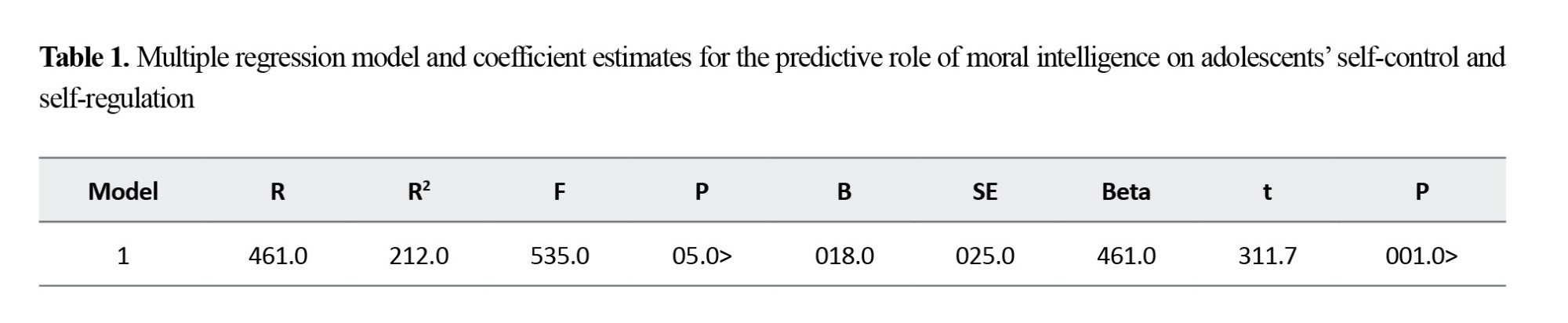
The results presented in Table 1 indicate that the multiple regression model of moral intelligence had significant predictive power for adolescents’ self-control and self-regulation. The multiple correlation coefficient (R = 0.461) reflected a relatively strong relationship between the variables examined. The coefficient of determination (R2=0.212) showed that about 21% of the variance of self-control and self-regulation was explained by moral intelligence. Also, the overall significance of the regression model was confirmed (F=0.535 and P=0.05) and the model had a good fit to predict the criterion variables. Also, the findings of the regression analysis showed that moral intelligence was a significant predictor of adolescents’ self-control and self-regulation (β=0.461, T=0.731). The regression coefficient (B=0.018) indicated that for each unit increase in the moral intelligence score, the self-control and self-regulation score increased by 0.025 units.
Conclusion
The findings of this study showed that moral intelligence was a positive and significant predictor of self-control and self-regulation in adolescent girls. These results are consistent with previous studies (Feng et al., 2024). The components of moral intelligence create an internal value framework that motivates adolescents to align their behaviors with these standards. This coordination requires the use of self-control to restrain conflicting impulses and the use of self-regulatory strategies to plan and monitor behavior in line with ethical goals. In other words, moral intelligence provides moral reason and direction for self-management.
Ethical Considerations
Compliance with ethical guidelines
This article is derived from a master’s thesis with the approved proposal code number 3003 at Shahid Rajaee Teacher Training University, Tehran. In order to comply with professional ethics and prevent any possible bias, all questionnaires were completed and collected without first and last names. Participation and filling out the questionnaires was completely voluntary and free from any coercion. The subjects were assured that all answers would remain confidential and only the overall result would be announced, and they were asked to answer the questionnaires with utmost accuracy and honesty.
Funding
This article was a extracted from the master's thesis Hamideh Atabi, approved by the in Department of Psychology and Educational Sciences, Faculty of Humanities, Shahid Rajaee Teacher Training University, Tehran. This research did not receive any grant from funding agencies in the public, commercial, or non-profit sectors.
Authors contributions
The initial writing of this article was based on the master’s thesis of the first author. The second author, as the supervisor and corresponding author, was responsible for content guidance and methodological supervision. The third author reviewed, integrated, and final edited the article.
Conflicts of interest
The authors declared no conflict of interest.
Acknowledgments
We are deeply grateful to all the students who participated and cooperated in this study.
Adolescence is a critical stage that requires the development of self-management skills, such as self-control and self-regulation. These skills play a crucial role in adolescents’ psychosocial adjustment and academic achievement (Duckworth et al., 2019; Shai & Yang, 2025). Conversely, weakness in these skills makes a person susceptible to academic failure and aggression (Laird et al., 2011). On the other hand, moral intelligence, with components, such as honesty, responsibility, and compassion (Aladamat et al., 2020), can provide a suitable motivational and cognitive platform for strengthening self-management. Despite the theoretical importance of this relationship, evidence in the Iranian context is scant and sometimes inconsistent. Several studies have addressed a positive relationship between moral intelligence and self-control (Manavipour, 2016; Shaabani et al., 2023) and self-regulation (Arashtnab et al., 2022; Hesampour and Rezaei, 2023). It is also necessary to consider the role of gender in this relationship, as adolescent girls may exhibit distinct patterns in moral development and self-regulation due to specific social pressures. This study aimed to identify the predictive role of moral intelligence on self-control and self-regulation in adolescent girls.
Research Methods
The present descriptive-correlational predictive study was fundamental in terms of its purpose and implementation. The statistical population was female ninth-grade students in Tehran in the 2023-2024 academic year. Using multi-stage cluster random sampling, 251 individuals were selected as the final sample. The instruments used were the Lenick and Keel’s Moral Intelligence Questionnaire (2005), the Tangey’s Self-Control Scale (2004), and the Bouffard’s Self-Regulation Questionnaire (1995). After obtaining informed consent and administering the questionnaires, the data were analyzed using Pearson’s correlation coefficient, multiple and stepwise regression analysis with SPSS software, version 27.
Findings
In this study, 251 ninth-grade female students with an average age of 15 participated. To test the main hypothesis, multiple regression analysis was performed, and the model results are presented in Table 1.
The results presented in Table 1 indicate that the multiple regression model of moral intelligence had significant predictive power for adolescents’ self-control and self-regulation. The multiple correlation coefficient (R = 0.461) reflected a relatively strong relationship between the variables examined. The coefficient of determination (R2=0.212) showed that about 21% of the variance of self-control and self-regulation was explained by moral intelligence. Also, the overall significance of the regression model was confirmed (F=0.535 and P=0.05) and the model had a good fit to predict the criterion variables. Also, the findings of the regression analysis showed that moral intelligence was a significant predictor of adolescents’ self-control and self-regulation (β=0.461, T=0.731). The regression coefficient (B=0.018) indicated that for each unit increase in the moral intelligence score, the self-control and self-regulation score increased by 0.025 units.
Conclusion
The findings of this study showed that moral intelligence was a positive and significant predictor of self-control and self-regulation in adolescent girls. These results are consistent with previous studies (Feng et al., 2024). The components of moral intelligence create an internal value framework that motivates adolescents to align their behaviors with these standards. This coordination requires the use of self-control to restrain conflicting impulses and the use of self-regulatory strategies to plan and monitor behavior in line with ethical goals. In other words, moral intelligence provides moral reason and direction for self-management.
Ethical Considerations
Compliance with ethical guidelines
This article is derived from a master’s thesis with the approved proposal code number 3003 at Shahid Rajaee Teacher Training University, Tehran. In order to comply with professional ethics and prevent any possible bias, all questionnaires were completed and collected without first and last names. Participation and filling out the questionnaires was completely voluntary and free from any coercion. The subjects were assured that all answers would remain confidential and only the overall result would be announced, and they were asked to answer the questionnaires with utmost accuracy and honesty.
Funding
This article was a extracted from the master's thesis Hamideh Atabi, approved by the in Department of Psychology and Educational Sciences, Faculty of Humanities, Shahid Rajaee Teacher Training University, Tehran. This research did not receive any grant from funding agencies in the public, commercial, or non-profit sectors.
Authors contributions
The initial writing of this article was based on the master’s thesis of the first author. The second author, as the supervisor and corresponding author, was responsible for content guidance and methodological supervision. The third author reviewed, integrated, and final edited the article.
Conflicts of interest
The authors declared no conflict of interest.
Acknowledgments
We are deeply grateful to all the students who participated and cooperated in this study.
References
Abol Maali, K., & Adel Pileh Ruod, M. (2021). The effects of sand play therapy on improvement of behavioral problems, self-control, and emotional intelligence of 6-year-old children. Journal of Childhood Health and Education, 2(3), 54-76. [Link]
Akande, O. W., Muzigaba, M., & Igumbor, E. U. (2024). The effectiveness of an m-Health intervention on the sexual and reproductive health of in-school adolescents: A cluster randomized controlled trial in Nigeria. Reproductive Health, 21, 6. [DOI:10.1186/s12978-023-01735-4]
Akbarzadeh, M. M., Imani, S., & Naghian, M. H. (2025). [The mediating role of self-control in the relationship between helicopter parenting and smartphone addiction in emerging adult students (Persian)]. Applied Psychology. [DOI:10.48308/apsy.2025.237315.1718]
Al-Adamat, A., Al-Gasawneh, J., & Al-Adamat, O. (2020). The impact of moral intelligence on green purchase intention. Management Science Letters, 10(9), 2063-2070. [DOI:10.5267/j.msl.2020.2.005]
Areshtanab, H. N., Rezvani, R., Ebrahimi, H., Bostanabad, M. A., & Hosseinzadeh, M. (2022). Moral intelligence and its relationship to resilience among nursing students in Iran. Journal of Psychiatric Nursing, 13(1), 9. [DOI:10.14744/phd.2021.49368]
Azadmanesh, M., Abul-Maali Al-Husseini, Kh., & Mohammadi, A. (2020). [Investigating the validity and reliability of the Persian version of the self-control questionnaire in students (Persian)]. Psychometrics, 8(32), 107-123. [Link]
Bagchi, D., Srivastava, A., & Tushir, B. (2024). Deciphering the global research trends and significance of moral intelligence via bibliometric analysis. Frontiers in Psychology, 15, 1425341. [DOI:10.3389/fpsyg.2024.1425341]
Bertrams, A. (2012). How minimal grade goals and self-control capacity interact in predicting test grades. Learning and Individual Differences, 22(6), 833-838. [DOI:10.1016/j.lindif.2012.07.003]
Borba, M. (2005). Building Moral Intelligence: The Seven Essential Virtues That Teach Kids to Do the Right Thing. San Francisco: The University of Michigan. [Link]
Bouffard, T., Boisvert, J., Vezeau, C., & Larouche, C. (1995). The impact of goal orientation on self-regulation and performance among college students. British Journal of Educational Psychology, 65(3), 317-329. [DOI:10.1111/j.2044-8279.1995.tb01152.x]
Bridgett, D. J., Burt, N. M., Edwards, E. S., & Deater-Deckard, K. (2015). Intergenerational transmission of self-regulation: A multidisciplinary review and integrative conceptual framework. Psychological Bulletin, 141(3), 602–654. [DOI:10.1037/a0038662]
de Ridder, D. (2024). Can self-control make you happy? Current Opinion in Psychology, 60, 101875. [DOI:10.1016/j.copsyc.2024.101875]
Duckworth, A. L., Taxer, J. L., Eskreis-Winkler, L., Galla, B. M., & Gross, J. J. (2019). Self-control and academic achievement. Annual Review of Psychology, 70, 373–399. [DOI:10.1146/annurev-psych-010418-103230]
Ezelote, C. J., Osuoji, N. J., & Mbachu, A. J. (2024). Effect of peer health education intervention on HIV/AIDS knowledge amongst in-school adolescents in secondary schools in Imo State, Nigeria. BMC Public Health, 24, 1029. [DOI:10.1186/s12889-024-18536-4]
Feng, Y., & Yang, Q. (2024). The differential influence of achievement motivation on subjective well-being and the moderating role of self-control. Scientific Reports, 14(1), 22102. [DOI:10.1038/s41598-024-73193-2]
Foroughi, A., Azar, G., Parvizifard, A., Khanjani, S., & Sadeghi, K. (2019). Psychometric properties of the Persian version of the Southampton mindfulness questionnaire. Clinical Psychology: Research and Practice Innovations, 11(2), 32-39. [DOI:10.22075/jcp.2019.17050.1634]
Gardner, H. (1983). Frames of mind: The theory of multiple intelligences. New York: Basic Books. [Link]
Gharibi, H., Naderian, A., & Saalahian, A. (2025). Predicting academic self-efficacy and self-regulation based on metamemory with the mediation of implicit intelligence beliefs. Research in School and Virtual Learning. [DOI:10.30473/etl.2025.70274.4142]
Gholipour, M., Jalalian, Z. S., & Taheri, F. (2023). The effectiveness of teaching the components of moral intelligence on self-control and scientific optimism in first secondary school students. Islamic Lifestyle with a Focus on Health, 6(4), 480-487. [Link]
Guo, Y. F., Yue, F. Y., Lu, X. Y., Sun, F. Y., Hu, X. L., & Jia, Y. N. (2024). Roles of self-efficacy and self-control in the association between relative deprivation and psychological well-being among undergraduate students during COVID-19 pandemic. Scientific Reports, 14(1), 24361. [DOI:10.1038/s41598-024-75769-4]
Hashemi, Y., & Keshavarz, S. (2025). The relationship between mothers’ emotional intelligence and aggressive behaviors in preschool children: The mediating role of children’s emotion regulation. Journal of Childhood Health and Education, 6(2), 333-347. [DOI:10.22034/jeche.6.2.333]
Hesampour, F., & Rezaei, A. M. (2023). The role of academic motivation, academic emotions, and moral intelligence in predicting students’ academic performance. Journal of Child Mental Health, 10(4), 63-78. [Link]
Jafari, M., & Berimani, A. (2021). The relationship between modern teaching methods and self-regulated learning strategies with the mediating role of perceptions of classroom activities in students. Curriculum and Educational Planning Research, 12(1), 285-300. [Link]
Jamaris, M., & Hartati, S. (2017). The role of the undergraduate students’ self-regulation and its influence to their academic achievements. International Journal of Multidisciplinary and Current Research, 5(3), 544-552. [DOI:10.14741/ijmcr/v.5.3.9]
Jamshidi, M. (2015). [A study of self-control in children and adolescents (Persian)]. Paper presented at: Second International Conference on Behavioral Sciences and Social Studies, 18 March 2016, Tehran, Iran. [Link]
Juliansen, A., Heriyanto, R. S., Muljono, M. P., Budiputri, C. L., Sagala, Y. D. S., & Octavius, G. S. (2024). Mental health issues and quality of life amongst school-based adolescents in Indonesia. Journal of Medicine, Surgery, and Public Health, 2, 100062. [DOI:10.1016/j.glmedi.2024.100062]
Kakavand, A., Mousavi, N., Shirmohammadi, F., Hejri, F., Haji Sharifi, R., & Qasemi Madani, H. (2023). Relationship between emotional self-regulation and online game addiction with the mediating role of loneliness in elementary school children. Journal of Childhood Health and Education, 4(1), 5. [DOI:10.32592/jeche.4.1.66]
Kargar, F., Fartash, S., & Sameti, N. (2023). The effectiveness of moral intelligence training program in moral emotion and responsibility of secondary elementary students in Tehran. Journal of School Psychology, 12(4), 125-137. [DOI:10.22098/jsp.2024.11338.5370]
Kline, R. B. (2023). Principles and practice of structural equation modeling. New York: Guilford Publications. [Link]
Laird, R. D., Marks, L. D., & Marrero, M. D. (2011). Religiosity, self-control, and antisocial behavior: Religiosity as a promotive and protective factor. Journal of Applied Developmental Psychology, 32(2), 78-85. [DOI:10.1016/j.appdev.2010.12.003]
Lennick, D., & Kiel, F. (2005). Moral Intelligence. Philadelphia: Wharton University of Pennsylvania. [Link]
Li, J., Gillebaart, M., & van Timmeren, T. (2024). Beliefs about self-control. Current Opinion in Psychology, 60, 101898. [DOI:10.1016/j.copsyc.2024.101898]
Liu, X. Q., & Wang, X. (2024). Adolescent suicide risk factors and the integration of social-emotional skills in school-based prevention programs. World Journal of Psychiatry, 14(4), 494–506. [DOI:10.5498/wjp.v14.i4.494]
Liu, X. Q., Guo, Y. X., Zhang, W. J., & Gao, W. J. (2022). Influencing factors, prediction and prevention of depression in college students: A literature review. World Journal of Psychiatry, 12(7), 860–873. [DOI:10.5498/wjp.v12.i7.860]
Mahdizadeh, M., Pakdaman, M., Ebrahimpor, M., & Saeidi, A. (2024). The effectiveness of self-regulation training based on creative representation on self-regulation and motivation of academic progress of primary school students. Journal of Childhood Health and Education, 5(2), 1. [DOI:10.32592/jeche.5.2.1]
Manavipour, M. (2017). [The relationship between self-control and moral intelligence with academic motivation of female students in the first year of Kavar high school (Persian)] [MA thesis]. Marvdasht: Islamic Azad University.
Masoudnia, M., Rahavi Ezabadi, R., & Khalil Marandi, P. (2025). Effect of physical activity on children’s self-regulation skills in three domains: Cognitive, emotional, and physical. Journal of Childhood Health and Education, 6(2), 179-191. [DOI:10.22034/jeche.6.2.179]
McClelland, M. M., Geldhof, G. J., Cameron, C. E., & Wanless, S. B. (2015). Development and self-regulation. In R. M. Lerner (Ed.), Handbook of child psychology and developmental science (pp. 1–43). John Wiley & Sons, Inc. [DOI:10.1002/9781118963418.childpsy114]
Mehralian, G., Bordbar, S., Bahmaei, J., Askarpour, H., & Yusefi, A. R. (2024). The impact of emotional and moral intelligence on nurses’ organizational commitment. BMC Nursing, 23(1), 800. [DOI:10.1186/s12912-024-02455-1]
Mirsamadi, H., Mohammadpour Yaghini, H., Janani, H., & Barqi Moghadam, J. (2024). Structural relationships of antisocial behaviors with emotion regulation strategies, the mediating role of moral intelligence in men. Shenakht Journal of Psychology and Psychiatry, 11(4), 80–94. [Link]
Mohammadi, F., Salimi, R., Khazaei, S., & Bijani, M. (2025). Design and psychometric testing of a moral intelligence instrument for pre-hospital emergency medical services personnel: A sequential-exploratory mixed-method study. BMC Emergency Medicine, 25(1), 13. [DOI:10.1186/s12873-025-01171-6]
Mohammadi, M., Mohammadi, S., Mehri, A., & Bagheri Mazraeh, F. (2020). Investigation of moral intelligence’s predictive components in students of Shahid Beheshti university of medical sciences (SBMU). Journal of Medical Ethics and History of Medicine, 13, 13. [DOI:10.18502/jmehm.v13i13.4389]
Prasertsin, U., Srihaset, K., & Roopsuwankun, P. (2024). Development of indicators and moral intelligence scales for junior high school students: mixed-method research. BMC Psychology, 12(1), 174. [DOI:10.1186/s40359-024-01640-w]
Rasyid, F. (2023). Learning styles, self-regulation and reading achievement: Evidence from Indonesia. In Conference on English Language Teaching (pp. 257–273). [Link]
Rezaei Rad, M. (2025). Design and implementation of personalized learning based on electronic learning tools and its impact on self-regulation abilities, academic self-efficacy and quality of students’ learning. Educational Innovations, 23(4), 157-172. [DOI:10.22034/jei.2024.398401.2640]
Samiei, N., & Khorramabadi, Y. (2024). [Investigating the relationship between self-regulation strategies and social support with academic creativity in twelfth grade male students in Kermanshah (Persian)]. Journal of New Advances in Psychology, Training and Education, 75(7), 78-93. [Link]
Schoon, I., Nasim, B., & Cook, R. (2021). Social inequalities in early childhood competences, and the relative role of social and emotional versus cognitive skills in predicting adult outcomes. British Educational Research Journal, 47(5), 1259–1280. [DOI:10.1002/berj.3724]
Shabani, J., & Sajedi, H. (2023). The effectiveness of moral intelligence group training on the conduct disorder of female students: Moral intelligence and students’ conduct disorder. International Journal of Applied Behavioral Sciences, 10(1), 28-36. [DOI:10.22037/ijabs.v10i1.38409]
Shi, Y., & Yang, H. (2025). Development, revision, and validation of a self-regulated learning questionnaire for Chinese undergraduate students. Acta Psychologica, 256, 104956. [DOI:10.1016/j.actpsy.2025.104956]
Sternberg, R. J. (2019). A theory of adaptive intelligence and its relation to general intelligence. Journal of Intelligence, 7(4), 23. [DOI:10.3390/jintelligence7040023]
Sun, C., Li, H., Wang, X., Shao, Y., Huang, X., & Qi, H., et al. (2024). Self-control as mediator and social support as moderator in stress-relapse dynamics of substance dependency. Scientific Reports, 14(1), 19852. [DOI:10.1038/s41598-024-70884-8]
Tangney, J. P., Baumeister, R. F., & Boone, A. L. (2004). High self- control predicts good adjustment, less pathology, better grades, and interpersonal success. Journal of Personality, 72, 271-324. [DOI:10.1111/j.0022-3506.2004.00263.x]
United Nations Children’s Fund (UNICEF). (2018). Demographics.UNICEF Data. USA: UNICEF. [Link]
Willems, Y. E., Li, J. B., Bartels, M., & Finkenauer, C. (2024). Individual differences in adolescent self-control: The role of gene-environment interplay. Current Opinion in Psychology, 60, 101897. [DOI:10.1016/j.copsyc.2024.101897]
Yarahmadi, S., Nobahar, M., Raiesdana, N., & Delshad, E. S. (2025). Self-compassion in nursing students and its correlations with moral intelligence, and moral perfectionism: A cross-sectional study. SAGE Open Nursing, 11, 23779608251320517. [DOI:10.1177/23779608251320517]
Yazıcı-Kabadayı, S., Mercan, O., & Öztemel, K. (2025). Cyberbullying roles and psychosocial dynamics: a latent profile analysis of loneliness, resilience, and self-regulation in adolescents. BMC Public Health, 25(1), 1480. [DOI:10.1186/s12889-025-22745-w]
Type of Study: Research |
Subject:
Special
Received: 2025/06/2 | Accepted: 2026/01/3 | Published: 2026/01/3
Received: 2025/06/2 | Accepted: 2026/01/3 | Published: 2026/01/3
Send email to the article author
| Rights and permissions | |
 |
This work is licensed under a Creative Commons Attribution-NonCommercial 4.0 International License. |