Volume 7, Issue 1 (Vol 7, No 1 2026)
2026, 7(1): 2-19 |
Back to browse issues page



Ethics code: IR.USWR.REC.


Download citation:
BibTeX | RIS | EndNote | Medlars | ProCite | Reference Manager | RefWorks
Send citation to:


BibTeX | RIS | EndNote | Medlars | ProCite | Reference Manager | RefWorks
Send citation to:
Aghapour K, Khodabandelou R, Tavakolian A, Karimzadeh M, Mohammadi Arya A. (2026). Predicting Behavioral Problems in Preschool Children Based on Socioeconomic Factors: The Mediating Role of Family Structure. Journal of Childhood Health and Education. 7(1), 2-19. doi:10.32598/JECHE.7.1.54.5
URL: http://jeche.ir/article-1-419-en.html
URL: http://jeche.ir/article-1-419-en.html
Khatereh Aghapour1  , Rouhollah Khodabandelou2 , Atena Tavakolian1 , Mansoureh Karimzadeh *1 , Alireza Mohammadi Arya3
, Rouhollah Khodabandelou2 , Atena Tavakolian1 , Mansoureh Karimzadeh *1 , Alireza Mohammadi Arya3
1- Department of Preschool Education, Faculty of Behavioral Sciences and Mental Health, University of Social Welfare And Rehabilitation Sciences, Tehran, Iran.
2- Department of Instructional & Learning Technologies, College of Education, Sultan Qaboos University, Muscat, Oman.
3- Department of Preschool Education, Faculty of Behavioral Sciences and Mental Health, University of Social Welfare and Rehabilitation Sciences, Tehran, Iran.
2- Department of Instructional & Learning Technologies, College of Education, Sultan Qaboos University, Muscat, Oman.
3- Department of Preschool Education, Faculty of Behavioral Sciences and Mental Health, University of Social Welfare and Rehabilitation Sciences, Tehran, Iran.
Full-Text [PDF 6267 kb]
(148 Downloads)
| Abstract (HTML) (927 Views)
Full-Text: (94 Views)
Introduction
Family is an important pillar of a society and the main environment for a child’s physical, emotional, and cognitive development. Children naturally regard the home environment as their primary refuge and their parents and relatives as the most trustworthy people (Khodavandi et al., 2026). The family is often considered a place of security and happiness (Mohammadzadeh et al., 2024). On the other hand, risk factors for behavioral problems in children are mainly related to family structure and socio-economic status (Yadgar et al., 2022). Behavioral problems are one of the most common mental health disorders in childhood, affecting 5-10% of children and resulting in enormous costs for families and society (O’Farrelly et al., 2021). Violence against children at home has more destructive effects, as the child loses trust in parents and becomes a norm-breaker (Shaghayegh et al., 2021). Behavioral problems in early childhood may hinder the development of a range of social, emotional, and cognitive skills in children. Untreated behavioral problems in early childhood can be detrimental (Ferraro et al., 2016). Behavioral problems can lead to family dysfunction; if children with behavioral problems enter the education system, they are harmed due to having low self-esteem and short attention spans, or can harm others due to having social communication problems (Nayebi, 2020; Shirmohammadi et al., 2024). Therefore, behavioral problems in children are considered one of the major threats to the family system, encouraging scholars to investigate the origins of this problem (Goodarzi et al., 2018; Behjat et al., 2025).
The COVID-19 pandemic made conditions difficult for the whole world in different parts. It began in Wuhan, China, in mid-December 2019, and gradually spread to all countries in the world (Abbasi et al., 2020). It has affected the entire social structure around the world; areas such as culture, economy, industry, and tourism, as well as the family structure and its socio-economic status (SES), were affected by this virus (Tavakolian et al., 2023). The conditions that COVID-19 imposed on families, such as psychological trauma, economic pressure, and quarantine, often contributed greatly to the emergence of behavioral problems in children (Baghri et al., 2023). Behavioral problems refer to behaviors that are not approved by society and are repetitive and persistent, which makes the child feel helpless in school performance (Taheri et al., 2025). The prevalence of these problems in primary school children varies from 2% to 12%, and factors such as domestic violence, peer relationships at school, age, gender, intelligence, and cultural and socio-economic factors are the most important causes of their occurrence (Eşkisu, 2014; Farah, 2017). Behavioral problems are mostly in the form of aggression and fear and have negative effects on social behavior during adolescence, and lack of parental recognition can exacerbate these problems (Akos et al., 2023).
Economic and familial factors can affect mental health (Nouri, 2018). One of the key variables in a child’s exposure to violence at home is the SES of the parents, which is an individual’s measure of the income level and occupational status (Heidarnezhad et al., 2016). Poverty is associated with stress, drug addiction, and poor nutrition and increases the risk of misbehavior (Bahari and Sotoudeh, 2016; Fernandes et al., 2020). Parents with lower economic status show a greater tendency towards harsh parenting (Pourvahed and Amiri Majd, 2017). Theoretical frameworks, such as Family Systems Theory, suggest that the family is an interconnected system where a change in the behavior of one member affects the psychological state of all members (Angela et al., 2016). In this system, what happens to one member will also happen to other members, which is related to the concept of complementarity (Jamshidi and Kakabaraee, 2017).
Considering the theoretical frameworks and the negative effects of the COVID-19 pandemic on family structure, this study aimed to investigate the relationship between SES and behavioral problems in pre-school children, mediated by family structure or child gender during the post-COVID era in Rumeshkan, Iran. Accordingly, the two main hypotheses of the research are: (1) There is a significant relationship between SES and behavioral problems mediated by family structure; (2) There is a significant relationship between SES and behavioral problems mediated by family structure and child gender.
Research Methods
Study design and participants
This is a descriptive-correlational study. The study population comprised all preschool children (aged 5-6) in kindergartens in Rumeshkan County during 2021-2022 (n=1150). Based on Krejcie and Morgan’s Table, a sample size of 288 was determined. A multi-stage cluster sampling method was employed to select samples. The county was divided into four geographical zones. From these, specific districts and kindergartens were randomly selected. Inclusion criteria were age 5-6 years and informed parental consent, while exclusion criteria were the presence of acute disabilities or chronic diseases in the child and failure to complete the questionnaires.
Instruments
The questionnaires that were used in this study included the Socio-Economic Status Scale (SESS), the Family Adaptability and Cohesion Evaluation Scale (FACES-III), and the Revised Behavior Problem Checklist (RBPC).
The SESS, developed by Ghodratnama et al. (2013), comprises 11 items measuring four domains: income, economic status, education, and housing status. Item scoring was based on a 5-point Likert scale from 1 (Very Low) to 5 (Very High). Based on the total score, the SES is grouped into five categories: Poor, Low, Moderate, High, and Excellent. For this scale, construct validity was confirmed with a KMO of 0.75 and internal consistency with a Cronbach’s alpha value of 0.72 (Ghodratnama et al. 2013). In our study, face and content validity were confirmed by experts, and the Cronbach’s alpha value was obtained at 0.72, which indicates appropriate internal consistency.
The FACES-III was developed by Olson et al. (1985). This 40-item tool measures two core dimensions: Cohesion and Adaptability. It uses a 5-point Likert scale. For this scale, Olson et al. (1985) reported a Cronbach’s alpha of 0.77 for Cohesion and 0.62 for Adaptability. For its Persian version, Ahangarkani et al. (2014) reported a Cronbach’s alpha of 0.74 for Cohesion and 0.75 for Adaptability. Also, the test-retest reliability coefficients for Cohesion and Adaptability were 0.83 and 0.80, respectively. In our study, face and content validity were confirmed by experts, and Cronbach’s alpha values were 0.74 and 0.75 for Cohesion and Adaptability, respectively, indicating acceptable internal consistency.
The RBPC was developed by Quay and Peterson (1987). This instrument, with 88 items assesses conduct disorder (items 1-38), attention problems/immaturity (items 39-71), social aggression (items 72-80), and anxiety-isolation (items 81-88). It utilizes a 3-point scale (0=Not a problem, 1=Mild problem, 2=Severe problem). For this tool, Quay and Peterson (1987) reported a construct validity with factor analysis as 0.82, a significant correlation with Rutter’s children behaviour questionnaire (r=0.88), and a Cronbach’s alpha of 0.96 to 0.98. For the Iranian version, Shahim et al., 2007), reported a Cronbach’s alpha coefficient of 0.97 for the overall scale. In the present study, face and content validity were confirmed by experts, and the Cronbach’s alpha coefficient was reported to be 0.98 for the entire scale, 0.97 for conduct disorder, 0.97 for attention problems/immaturity, 0.82 for social aggression, and 0.85 for anxiety-isolation, indicating the high internal consistency of this instrument.
Data analysis
First, ethical approval from the University of Social Welfare and Rehabilitation Sciences and permits from the Education Department in Lorestan province were obtained. Then, taking into account ethical considerations, the purpose of the study was explained to the participants, and the questionnaires were distributed among the parents of children who provided informed consent. After collecting data, they were analyzed in SPSS software, version 23 using descriptive statistics and multiple regression analysis (simultaneous method). The Kolmogorov-Smirnov (K-S) test was used for testing the normality of data distribution, and Levene’s test for testing the homogeneity of variances.
Results
Among 288 children, 50.69% (n=146) were girls and 47.56% (n=137) were boys. Parental reports indicated that 47.56% of mothers had a high school diploma or lower education, while 37.50% of fathers held a bachelor’s degree. In terms of occupation, the majority of fathers (72.56%) were employed, while only 33.68% of mothers were employed, and the majority (62.15%) were unemployed or housekeepers. Economically, over 52% of families reported a monthly income of <10 million Tomans, indicating a low- to middle SES.
Table 1 presents the results of the K-S test. The p-values for all study variables, including behavioral problems (P=0.289), family structure (P=0.315), and SES (P=0.412), were greater than 0.05.
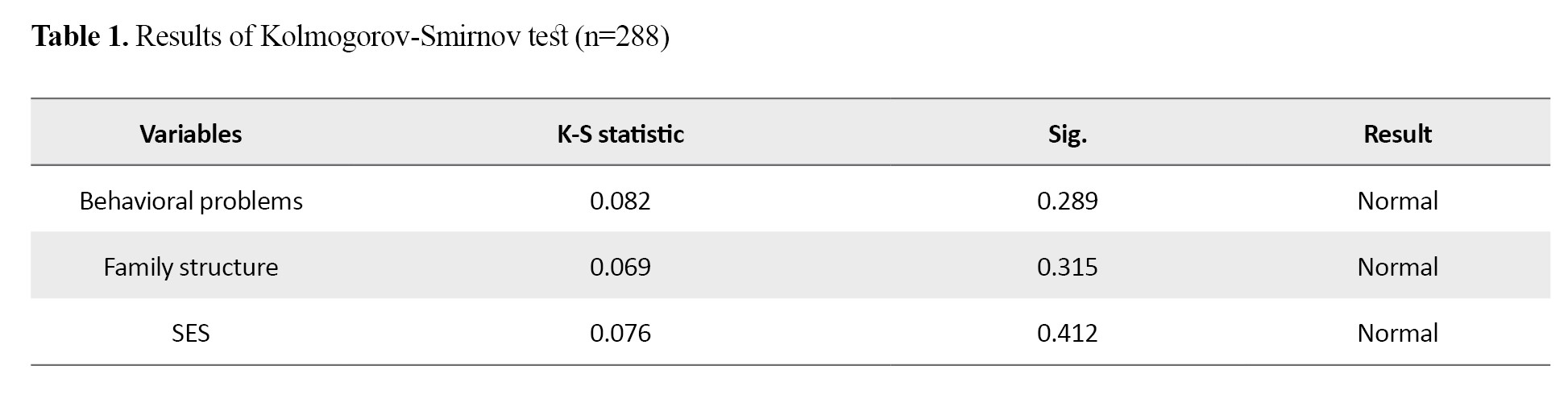
Therefore, the assumption of normal data distribution was confirmed and the use of parametric tests (such as regression) is permitted. Table 2 presents the results of Levene’s test.
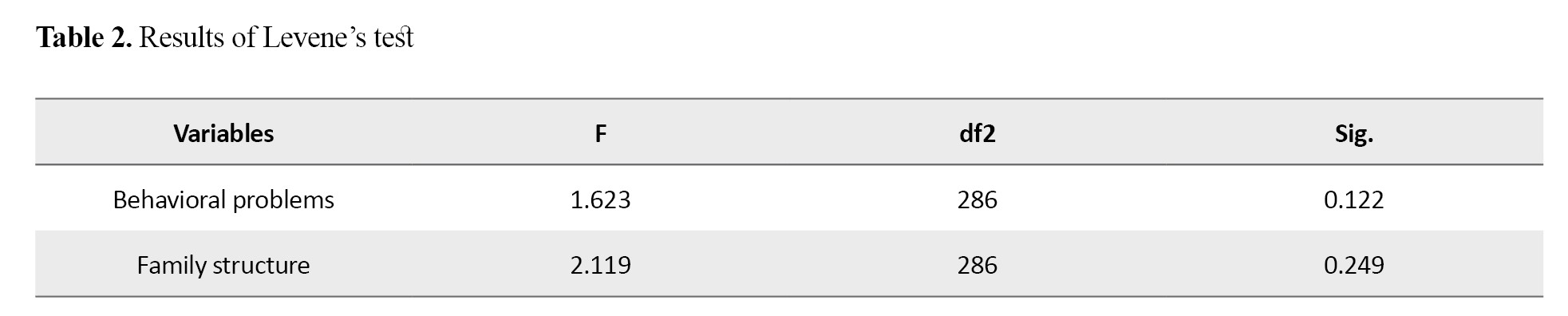
The P level of variables was greater than 0.05. Therefore, the assumption of homogeneity of variances was confirmed.
To analyze the first hypothesis, a simultaneous regression analysis was used, the results of which are shown in Tables 3, 4, and 5.
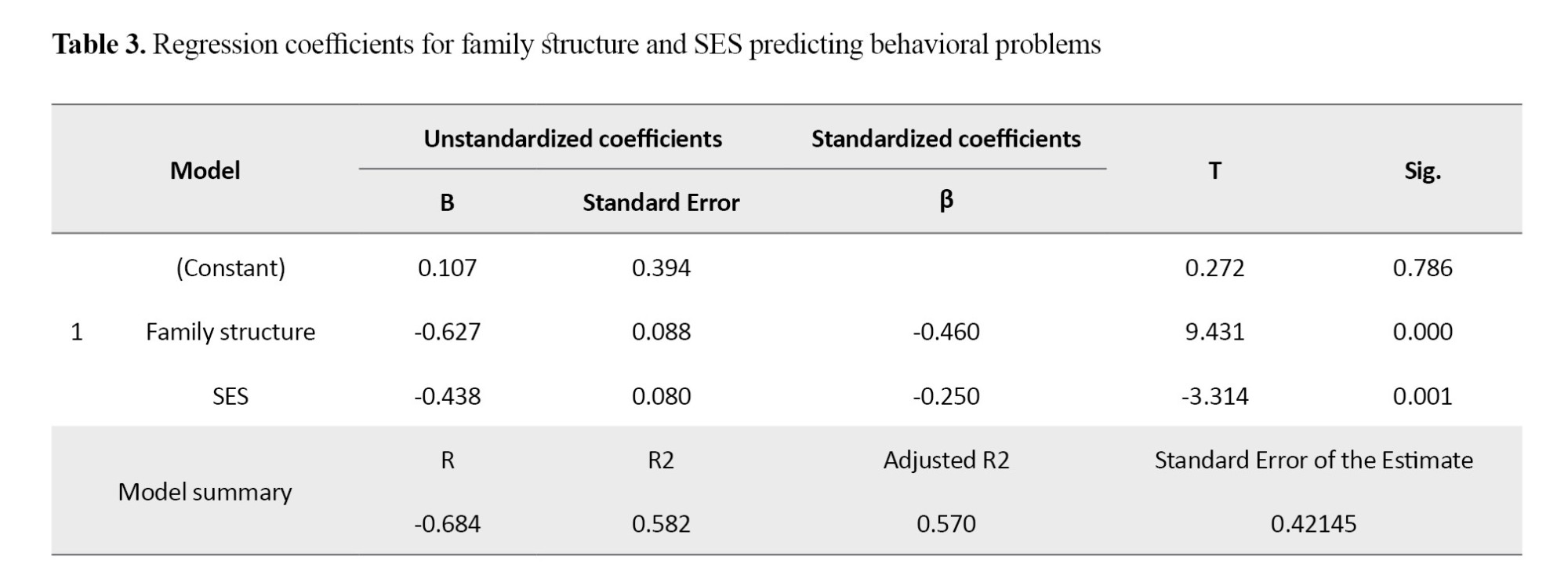
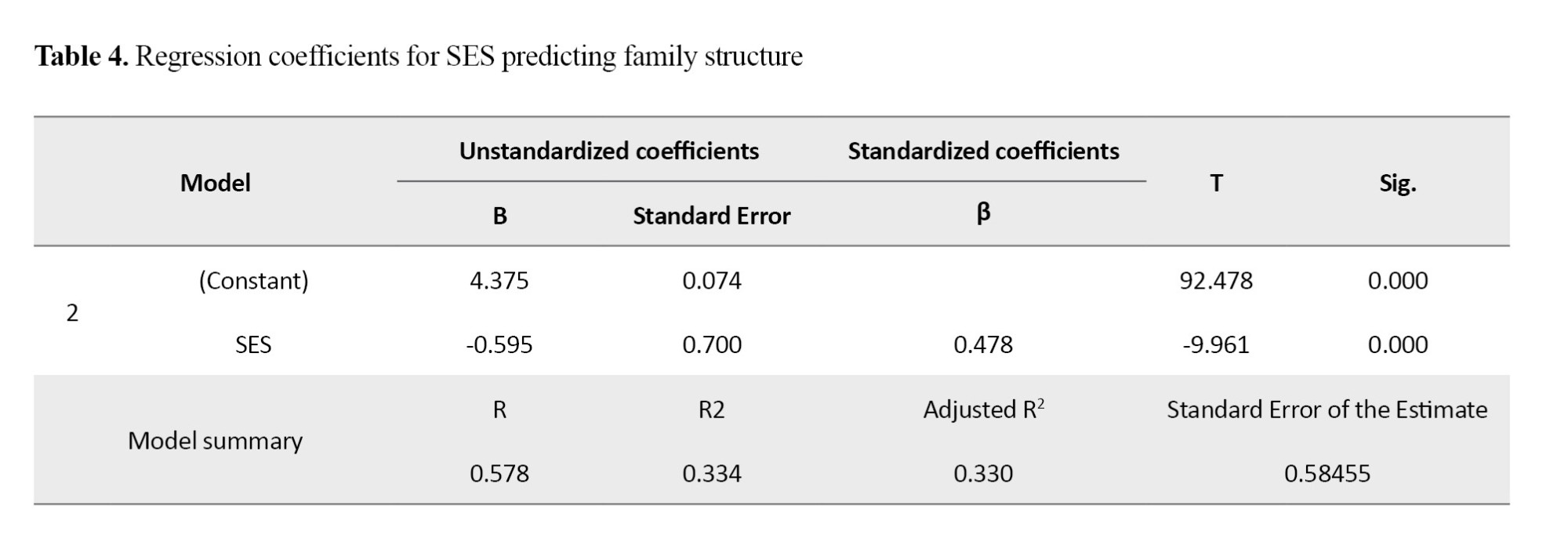
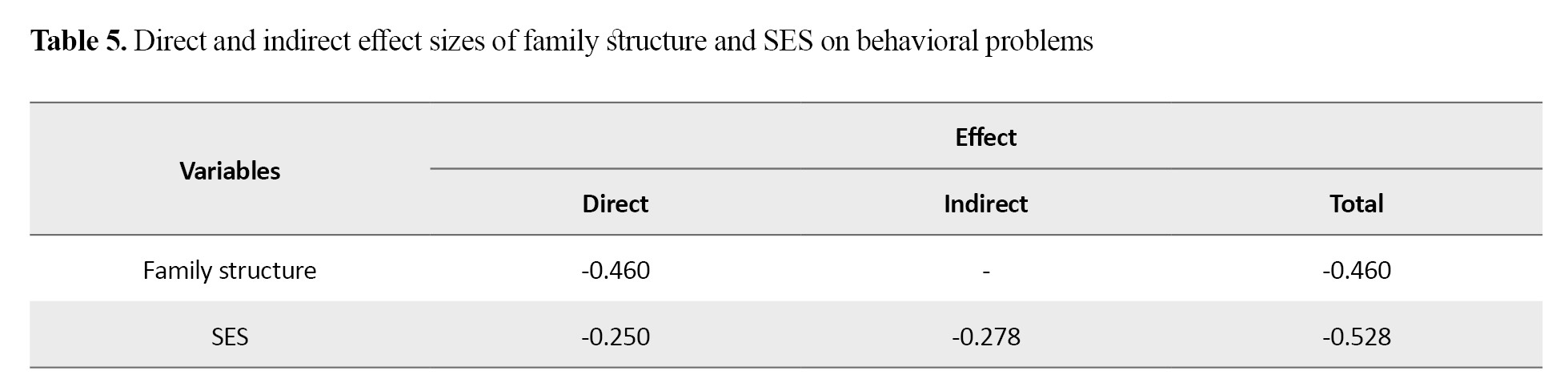
According to the results in Table 3, the first regression model could explain 58.2% of the variance in behavioral problems. In this model, family structure (β=-0.460) and SES (β=-0.250) were negative and significant predictors of behavioral problems, meaning that improving SES and family structure reduces children’s behavioral problems. Given the greater contribution of family structure in predicting behavioral problems, in the next step, regression analysis was conducted to examine the effect of SES on family structure to determine the mediating role of this variable. The results are presented in Table 4. As can be seen, SES, with a beta coefficient of 0.478 and P<0.001, had a direct association with family structure and was able to explain 33.4% of the variance in family structure. This finding shows that SES is a determinant of family structure, and changes in this factor directly affect family cohesion and adaptability. For a more comprehensive analysis, the total direct and indirect effects of SES and family structure on behavioral problems were assessed. As can be seen in Table 5, in the second regression model, family structure had only a direct association (β=-0.460) with behavioral problems, while SES had both a direct (β=-0.250) and an indirect effect through family structure (β=-0.278). The total effect of this variable was -0.528, which indicates that SES is not only effective alone, but also reduces children’s behavioral problems through making changes in family structure.
To analyze the second hypothesis, a multiple linear regression analysis was conducted, and the results are presented in Tables 6, 7, and 8.
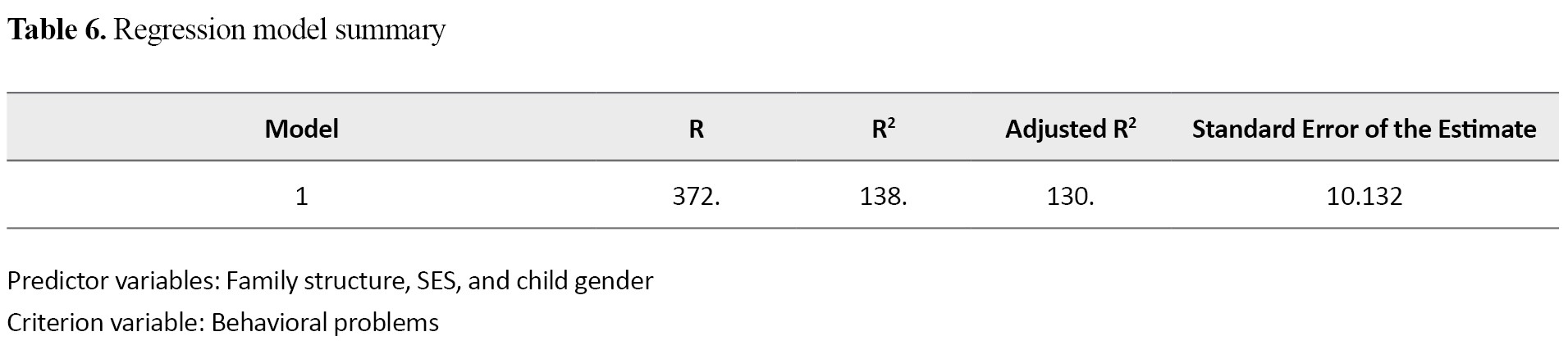
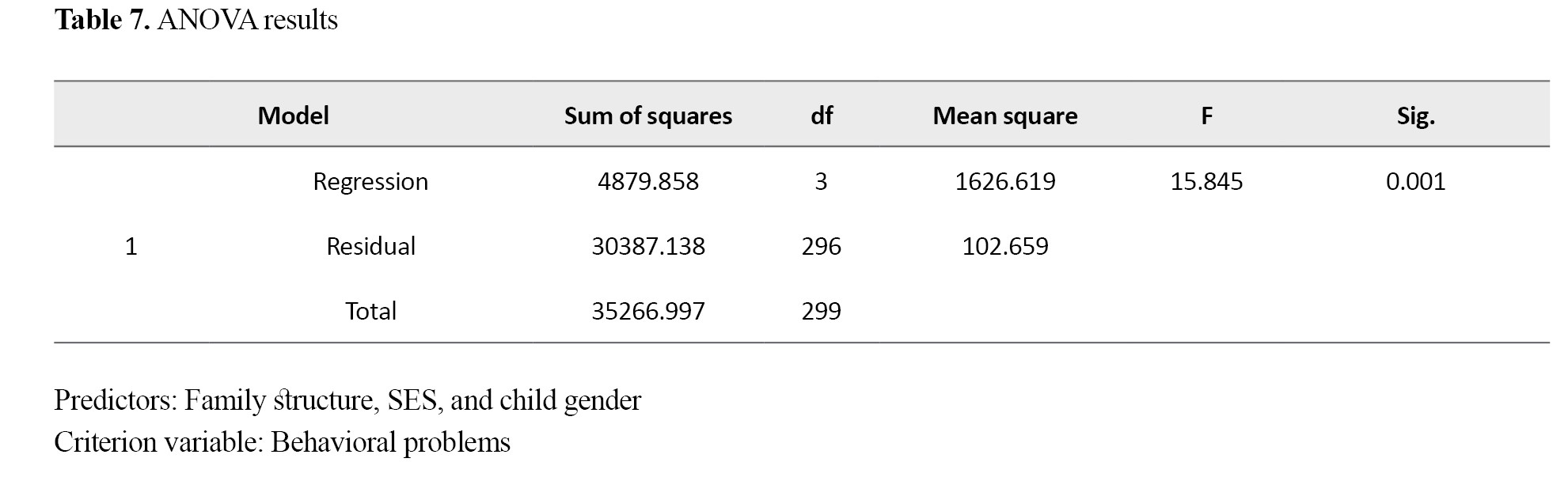
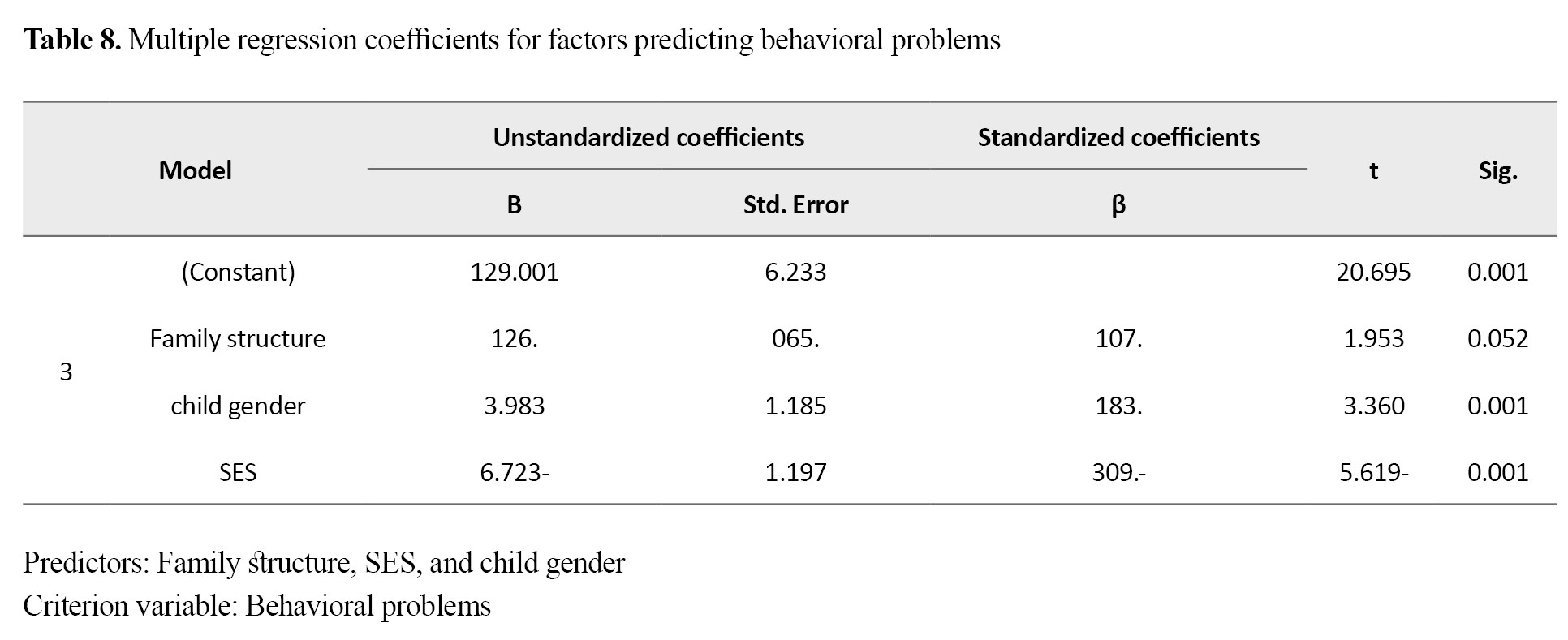
According to the results in Table 6, the multiple correlation coefficient (R) was 0.372, and the coefficient of determination (R²) was 0.138, indicating that about 14% of the variance in children’s behavioral problems was explained by family structure, SES, and child gender. To examine the significance of this model, the analysis of variance (ANOVA) was performed (Table 7). Since, P=0.001, the regression model was significant, and the combined effect of SES, child gender, and family structure on behavioral problems was confirmed. According to the results in Table 8, in the final regression model, SES with a beta coefficient of -0.309 (P=0.001) and child gender with a beta coefficient of 0.183 (P=0.001) were the significant predictors of behavioral problems, while family Structure with a beta coefficient of 0.107 and P=0.052 was on the borderline of statistical significance.
Discussion and conclusion
The purpose of this study was to comprehensively investigate the relationship between SES and behavioral problems among preschool children in an Iranian city, with a focus on the mediating role of family structure and child gender.
Regarding the first research hypothesis, the findings showed an inverse and significant association between the SES of parents and the occurrence of behavioral problems in children; i.e., as the SES decreases, the rate of behavioral problems in children increases. This result is in complete agreement with the findings of Yadgar et al. (2022), Goodarzi et al. (2018), and Behjat et al. (2025). Similar to the view of Heydarnejhad et al. (2016), economic capital can buffer against psychological harm, beyond being a mere financial source. Although there may be discrepancies between studies, possibly due to moderating variables such as social support, the effect of economic status on children’s behavior has been highlighted in Romeshkan County, given specific conditions and resulting financial pressures (Tavakolian et al., 2023). According to Bahari and Sotoudeh (2016), poverty and livelihood limitations reduce parents’ tolerance by causing chronic stress and improper nutrition. According to the Family Systems Theory (Angela et al. 2016), the family is one whole system in which environmental and economic pressures imposed on parents are directly transmitted to children. Furthermore, according to Fernandes (2020), parents with lower economic status are more likely to adopt authoritarian parenting styles and show harsh and violent behaviors due to suffering from daily stressors, which is considered the main driver of behavioral problems in children. Overall, SES, as an underlying variable, affects the stability of family structure. When financial pressures increase, the internal cohesion of the family weakens and parenting roles are disrupted; this disruption in the family structure creates an unsafe environment for the child and ultimately leads to the formation of abnormal behavioral patterns. Therefore, poor family structure causes poverty to act not only as a financial problem, but also as a destructive factor in family relationships that causes behavioral problems in children.
Regarding the second hypothesis, the results showed that child gender, along with family structure and SES, were significant predictors of behavioral problems in children. This finding is consistent with the results of Eşkisu (2014) and Farah (2017), who emphasized the effects of gender and cultural factors on the occurrence of aggressive behaviors in children. In contrast to the results of Akos et al. (2023), this study showed that child gender can change the intensity of being affected by family problems. In explaining this issue, based on the Family Systems Theory and the complementarity concept of Jamshidi and Kakabaraee (2017), it can be said that the family structure face tension due to excessive stay of members at home during COVID-19 pandemic (Bagheri et al., 2023) and this tension manifests itself in different forms (such as anxiety or aggression) in children with different genders. Also, according to Shaghayegh et al. (2021), when the family environment is no longer safe, the child loses trust in the parents and, regardless of gender, is driven towards norm-breaking; the severity of this norm-breaking is influenced by gender and societal expectations of the child.
Based on the research findings, economic and social pressures do not directly cause behavioral problems in children; rather, they first weaken family adaptability and cohesion, which are then transmitted to the child through tension in the home environment. In this process, the child’s gender acts as a moderator. Boys and girls, due to biological differences and different expectations of society from them, demonstrate different behaviors resulting from family problems such as externalized behaviors (aggression) vs. internalized behaviors (anxiety). In fact, family structure serves as the primary conduit for transmitting environmental stressors and determines the gender, type, and severity of these behavioral reactions. The COVID-19 pandemic affected all sectors of society, and this study showed that in Romeshkan County, these effects manifested as increased behavioral problems among preschool children. If these problems are not treated at this age, they will hinder the development of emotional competencies and lead the child to enter the educational system with low self-esteem, which will have enormous costs for society (Ferraro et al. 2016; Naeini, 2020; O’Farrelly et al., 2021). Family structure acts as a mediator: economic pressures first erode the quality of parent-child relationships, and this structural destruction then manifests as behavioral problems in the child.
In conducting this study, we encountered some limitations, including the lack of cooperation from some preschool managers in the early phase of the study, the difficulty and time-consuming process of obtaining legal permits to visit preschools and conduct interviews, and insufficient motivation and interest among some children to answer questions. In addition, the limited age range of 5-6 years and the reliance on self-report instruments, which may be biased, were some limitations for the generalization of the findings. Further studies on children at higher educational levels, including elementary school students, and examining the stability of behavioral problems over time are recommended. Future research should use mixed-methods designs (quantitative-qualitative) and direct observations, along with self-report instruments, to improve the accuracy of the outcome and enable greater generalization of the findings. Based on the results, health institutions and schools in Romeshkan County should develop family education courses focused on anger management and on replacing punishment with open, interactive alternatives to reduce the destructive effects of poor family structure on children. It is essential that social welfare policymakers focus on poverty alleviation, provide necessary economic aid to families in underserved areas, and design indigenous interventions appropriate to the region’s culture.
Ethical Considerations
Compliance with ethical guidelines
This study was conducted in adherence to the ethical principles for human research and received approval from the Ethics Committee of the University of Rehabilitation and Social Health Sciences (Code: IR.USWR.REC.1403.045). The parents of children were assured of the confidentiality of their information and were free to leave the study at any time. Informed consent was obtained from them.
Funding
This study was extracted from the master’s thesis of Khatereh Aghapour, Approved by the Department of Preschool Education, University of Rehabilitation and Social Health Sciences. This research did not receive any specific grant from funding agencies in the public, commercial, or not-for-profit sectors.
Authors contributions
Conceptualization, design, and writing: first and second authors; review & editing: third and forth authors
Conflicts of interest
The authors declared no conflict of interest.
Acknowledgments
The authors would like to thank all participants for their cooperation and time in this research.
References
Abbasi, F., Hejazi, E., & Hakimzadeh, R. (2020). [Elementary school teachers’ lived experience of opportunities and challenges of teaching in the student educational network (SHAD): A phenomenological study (Persian)]. Journal of Teaching Research, 8(3), 1-24. [Link]
Ahangarkani, M., ZadeMohammadi, A., Heidari, M., & Talebi, M. (2014). [The relationshib between marital values and reliegion oreiantation with family structure in male and female married individuals (Persian)] Journal of Research in Behavioural Sciences, 12(1), 44-57. [Link]
Tóth, Á. L., Kívés, Z., Szovák, E., Kresák, R., Jeges, S., & Kertai, B., et al. (2023). Sense of Coherence and Self-Rated Aggression of Adolescents during the First Wave of the COVID-19 Pandemic, with a Focus on the Effects of Animal Assisted Activities. International Journal of Environmental Research and Public Health, 20(1), 769. [DOI:10.3390/ijerph20010769] [PMID] [PMCID]
Angela, K. H., Shannon, M. V., Alyssa, M., & Patrick, H. T. (2016). Family Functioning and High Risk Adolescents’ Aggressive Behavior: Examining Effects by Ethnicity. Journal of Youth and Adolescence, 45(1), 145-155. [DOI:10.1007/s10964-014-0222-8] [PMID]
Bagheri, F., Hossienkhanzadeh, A. A., Farahani, H., & Fathi-Ashtiani, A. (2023). [Domestic violence against children and women during the Coronavirus 2019 pandemic (COVID-19): A systematic review study (Persian)]. Journal of Health, 14(2), 127-140. [Link]
Bahari, S., & Sotodeh, H. (2016). The pathology of family. Tehran: Niday-e-Aryana Publications. [Link]
Behjat, B., Semsar Yazdim S., & Demehri, F. (2025). [Comparing of the Effects of Parent-child Interaction Therapy and Childparent Relationship Therapy on Behavioral Problems and Family Functioning in Preschool Children (Persian)]. Journal of Childhood Health and Education, 6(3), 362-375. [Link]
Eşkisu, M. (2014). The relationship between bullying, family functions, perceived social support among high school students. Procedia-Social and Behavioral Sciences, 159, 492-496. [DOI:10.1016/j.sbspro.2014.12.412]
Farah, M. J. (2017). The neuroscience of socioeconomic status: Correlates, causes, and consequences. Neuron, 96(1), 56-71. [DOI:10.1016/j.neuron.2017.08.034] [PMID] [PMCID]
Fernandes, N. (2020). Economic effects of coronavirus outbreak (COVID-19) on the world economy. IESE Business School Working Paper, No. WP-1240-E, [DOI:10.2139/ssrn.3557504]
Ferraro, K. F., Schafer, M. H., & Wilkinson, L. R. (2016). Childhood disadvantage and health problems in middle and later life: Early imprints on physical health?. American Sociological Review, 81(1), 107-133. [DOI:10.1177/0003122415619617] [PMID] [PMCID]
Ghodratnama, A., Heidari Nejad, S., & Davoodi, I. (2013). [The relationship between socio-economic status and physical activity level of Shahid Chamran University students in Ahvaz (Persian)]. Sport Management Journal, 5(16), 5-20. [DOI:10.22059/jsm.2013.30410]
Goudarzi, M., Hashemi, R., & Taghavi, M. (2018). [The effect of Barkley’s parental behavior training program for mothers on reducing behavioral problems in elementary school children with conduct disorder (Persian)]. Knowledge & Research in Applied Psychology, 19(1), 1-9. [Link]
Heidarnejad, A., Sasan, V., & Torkaman, F. (2016). Investigating the relationship between socio-economic status, lifestyle and job security of police officers in Tehran. Social Security Quarterly, 42, 2-202.
Henneberger, A. K., Varga, S. M., Moudy, A., & Tolan, P. H. (2016). Family functioning and high risk adolescents’ aggressive behavior: Examining effects by ethnicity. Journal of Youth and Adolescence, 45(1), 145-155. [DOI:10.1007/s10964-014-0222-8] [PMID] [PMCID]
Jamshidi, R., & Kakabaraee, K. (2017). Determining the relationship between the use of cyberspace with behavioral problems (aggressive behavior, withdrawal and depression) of adolescents. 10th International Conference on Psychology and Social Sciences, Tehran. [Link]
Khodavandi, Z., Kiani, Q., & Sobhi A. (2026). [The effectiveness of gestalt play therapy on internalizing and externalizing problems in children (Persian)]. Journal of Childhood Health and Education, 7(1). [Link]
Mohamadzade, R., Hasannataj, F., & Taghipour Javan, A . A. (2025). [The Effectiveness of the Floortime Program on Behavioral Problems and Parent-child Interaction in Children with Attention Deficit Hyperactivity Disorder (Persian)]. Journal of Childhood Health and Education, 5(4), 161-171. [DOI:10.32592/jeche.5.4.161]
Nayebi, M. (2020). The effect of economic factors on the aggression of elementary school children Case study: Comparison of the type and amount of aggression in students in poor and affluent urban areas of Qazvin province. Paper presented at: 6th International Conference on Psychology, Educational Sciences and Lifestyle, Tbilisi, Georgia, 15 September ; 2020. [Link]
Noori, S. M. [Domestic Violence against Children: Nature, Reason and Some Solutions for Its Treatment in the Light of Legal Attempts (In Persian)]. Human Rights. 2007; 02(2):35-54. [link]
O’Farrelly, C., Watt, H., Babalis, D., Bakermans-Kranenburg, M. J., Barker, B., & Byford, S., et al. (2021). A brief home-based parenting intervention to reduce behavior problems in young children: A pragmatic randomized clinical trial. JAMA Pediatrics, 175(6), 567–576. [DOI:10.1001/jamapediatrics.2020.6834] [PMID] [PMCID]
Olson, D. H., Portner, J., & Lavee, Y. (1985). “Faces III”: Family Adaptability & Cohesion Evaluation Scales, Family Social Science. St. Paul: University of Minnesota. [Link]
Pourvahed, A., & Amiri Majd, M. (2017). [The relationship between mother’s psychological problems and family violence with behavioral problems of children with intellectual disability (Persian)]. Social Health Journal, 4(2), 110-117. [DOI:10.22037/ch.v4i2.14943]
Quay, H. C., & Peterson, D. R. (1987). Manual for the Revised Behavior Problem Checklist. Miami: University of Miami. [Link]
Shahim, S., Yousefi, F., & Ganbari Mazidi, M. (2007). [Psychometric properties of the revised Quay and Peterson behavior problem checklist (Persian)]. Iranian Journal of Psychiatry and Clinical Psychology, 13(4), 350-358. [Link]
Shaqayeq, M., Barzegar, K., & Rahimi, M. (2021). [The role of family factors in the aggression of preschool children with the mediation of social skills (Persian)]. Journal of Tolo-e-Behdasht, 20(1), 38-54. [DOI:10.18502/tbj.v20i1.6183]
Shirmohammadi, F., Mousavi, N., Kakavand, A., Abbasi, N., & Dabiri, T. (2024). [The Mediating Role of Parental Stress in the Relationship Between Mindful Parenting and Behavioural Problems in Preschool Children (Persian)]. Journal of Childhood Health and Education, 5(1), 67-79. [Link]
Taheri, S., Mohammadi Arya, A., Karimzadeh, M., & Vahedi, M. (2025). Determining the effectiveness of life skills training on behavioral problems and resilience of working children in Karaj (boys 7 to 13 years old). Journal of Childhood Health and Education, 6(1), 64-75. [Link]
Tavakolian, A., Zibaei, N., & Karimzadeh, M. (2023). Determining the relationship between aggression and family structure with the mediation of parents’ socio-economic factors among preschool children. 7th International School Psychology Congress, Tehran. [Link]
Yadegar, P., Tahmasebi, S., Karimzadeh, M., & Hosseinzadeh, S. (2022). Determining the relationship between domestic violence towards preschool children (4 to 6 years old) with individual and socio-economic factors of the family during the corona pandemic in Hamadan. 5th International Conference on Educational Psychology, Tehran. [Link]
Family is an important pillar of a society and the main environment for a child’s physical, emotional, and cognitive development. Children naturally regard the home environment as their primary refuge and their parents and relatives as the most trustworthy people (Khodavandi et al., 2026). The family is often considered a place of security and happiness (Mohammadzadeh et al., 2024). On the other hand, risk factors for behavioral problems in children are mainly related to family structure and socio-economic status (Yadgar et al., 2022). Behavioral problems are one of the most common mental health disorders in childhood, affecting 5-10% of children and resulting in enormous costs for families and society (O’Farrelly et al., 2021). Violence against children at home has more destructive effects, as the child loses trust in parents and becomes a norm-breaker (Shaghayegh et al., 2021). Behavioral problems in early childhood may hinder the development of a range of social, emotional, and cognitive skills in children. Untreated behavioral problems in early childhood can be detrimental (Ferraro et al., 2016). Behavioral problems can lead to family dysfunction; if children with behavioral problems enter the education system, they are harmed due to having low self-esteem and short attention spans, or can harm others due to having social communication problems (Nayebi, 2020; Shirmohammadi et al., 2024). Therefore, behavioral problems in children are considered one of the major threats to the family system, encouraging scholars to investigate the origins of this problem (Goodarzi et al., 2018; Behjat et al., 2025).
The COVID-19 pandemic made conditions difficult for the whole world in different parts. It began in Wuhan, China, in mid-December 2019, and gradually spread to all countries in the world (Abbasi et al., 2020). It has affected the entire social structure around the world; areas such as culture, economy, industry, and tourism, as well as the family structure and its socio-economic status (SES), were affected by this virus (Tavakolian et al., 2023). The conditions that COVID-19 imposed on families, such as psychological trauma, economic pressure, and quarantine, often contributed greatly to the emergence of behavioral problems in children (Baghri et al., 2023). Behavioral problems refer to behaviors that are not approved by society and are repetitive and persistent, which makes the child feel helpless in school performance (Taheri et al., 2025). The prevalence of these problems in primary school children varies from 2% to 12%, and factors such as domestic violence, peer relationships at school, age, gender, intelligence, and cultural and socio-economic factors are the most important causes of their occurrence (Eşkisu, 2014; Farah, 2017). Behavioral problems are mostly in the form of aggression and fear and have negative effects on social behavior during adolescence, and lack of parental recognition can exacerbate these problems (Akos et al., 2023).
Economic and familial factors can affect mental health (Nouri, 2018). One of the key variables in a child’s exposure to violence at home is the SES of the parents, which is an individual’s measure of the income level and occupational status (Heidarnezhad et al., 2016). Poverty is associated with stress, drug addiction, and poor nutrition and increases the risk of misbehavior (Bahari and Sotoudeh, 2016; Fernandes et al., 2020). Parents with lower economic status show a greater tendency towards harsh parenting (Pourvahed and Amiri Majd, 2017). Theoretical frameworks, such as Family Systems Theory, suggest that the family is an interconnected system where a change in the behavior of one member affects the psychological state of all members (Angela et al., 2016). In this system, what happens to one member will also happen to other members, which is related to the concept of complementarity (Jamshidi and Kakabaraee, 2017).
Considering the theoretical frameworks and the negative effects of the COVID-19 pandemic on family structure, this study aimed to investigate the relationship between SES and behavioral problems in pre-school children, mediated by family structure or child gender during the post-COVID era in Rumeshkan, Iran. Accordingly, the two main hypotheses of the research are: (1) There is a significant relationship between SES and behavioral problems mediated by family structure; (2) There is a significant relationship between SES and behavioral problems mediated by family structure and child gender.
Research Methods
Study design and participants
This is a descriptive-correlational study. The study population comprised all preschool children (aged 5-6) in kindergartens in Rumeshkan County during 2021-2022 (n=1150). Based on Krejcie and Morgan’s Table, a sample size of 288 was determined. A multi-stage cluster sampling method was employed to select samples. The county was divided into four geographical zones. From these, specific districts and kindergartens were randomly selected. Inclusion criteria were age 5-6 years and informed parental consent, while exclusion criteria were the presence of acute disabilities or chronic diseases in the child and failure to complete the questionnaires.
Instruments
The questionnaires that were used in this study included the Socio-Economic Status Scale (SESS), the Family Adaptability and Cohesion Evaluation Scale (FACES-III), and the Revised Behavior Problem Checklist (RBPC).
The SESS, developed by Ghodratnama et al. (2013), comprises 11 items measuring four domains: income, economic status, education, and housing status. Item scoring was based on a 5-point Likert scale from 1 (Very Low) to 5 (Very High). Based on the total score, the SES is grouped into five categories: Poor, Low, Moderate, High, and Excellent. For this scale, construct validity was confirmed with a KMO of 0.75 and internal consistency with a Cronbach’s alpha value of 0.72 (Ghodratnama et al. 2013). In our study, face and content validity were confirmed by experts, and the Cronbach’s alpha value was obtained at 0.72, which indicates appropriate internal consistency.
The FACES-III was developed by Olson et al. (1985). This 40-item tool measures two core dimensions: Cohesion and Adaptability. It uses a 5-point Likert scale. For this scale, Olson et al. (1985) reported a Cronbach’s alpha of 0.77 for Cohesion and 0.62 for Adaptability. For its Persian version, Ahangarkani et al. (2014) reported a Cronbach’s alpha of 0.74 for Cohesion and 0.75 for Adaptability. Also, the test-retest reliability coefficients for Cohesion and Adaptability were 0.83 and 0.80, respectively. In our study, face and content validity were confirmed by experts, and Cronbach’s alpha values were 0.74 and 0.75 for Cohesion and Adaptability, respectively, indicating acceptable internal consistency.
The RBPC was developed by Quay and Peterson (1987). This instrument, with 88 items assesses conduct disorder (items 1-38), attention problems/immaturity (items 39-71), social aggression (items 72-80), and anxiety-isolation (items 81-88). It utilizes a 3-point scale (0=Not a problem, 1=Mild problem, 2=Severe problem). For this tool, Quay and Peterson (1987) reported a construct validity with factor analysis as 0.82, a significant correlation with Rutter’s children behaviour questionnaire (r=0.88), and a Cronbach’s alpha of 0.96 to 0.98. For the Iranian version, Shahim et al., 2007), reported a Cronbach’s alpha coefficient of 0.97 for the overall scale. In the present study, face and content validity were confirmed by experts, and the Cronbach’s alpha coefficient was reported to be 0.98 for the entire scale, 0.97 for conduct disorder, 0.97 for attention problems/immaturity, 0.82 for social aggression, and 0.85 for anxiety-isolation, indicating the high internal consistency of this instrument.
Data analysis
First, ethical approval from the University of Social Welfare and Rehabilitation Sciences and permits from the Education Department in Lorestan province were obtained. Then, taking into account ethical considerations, the purpose of the study was explained to the participants, and the questionnaires were distributed among the parents of children who provided informed consent. After collecting data, they were analyzed in SPSS software, version 23 using descriptive statistics and multiple regression analysis (simultaneous method). The Kolmogorov-Smirnov (K-S) test was used for testing the normality of data distribution, and Levene’s test for testing the homogeneity of variances.
Results
Among 288 children, 50.69% (n=146) were girls and 47.56% (n=137) were boys. Parental reports indicated that 47.56% of mothers had a high school diploma or lower education, while 37.50% of fathers held a bachelor’s degree. In terms of occupation, the majority of fathers (72.56%) were employed, while only 33.68% of mothers were employed, and the majority (62.15%) were unemployed or housekeepers. Economically, over 52% of families reported a monthly income of <10 million Tomans, indicating a low- to middle SES.
Table 1 presents the results of the K-S test. The p-values for all study variables, including behavioral problems (P=0.289), family structure (P=0.315), and SES (P=0.412), were greater than 0.05.
Therefore, the assumption of normal data distribution was confirmed and the use of parametric tests (such as regression) is permitted. Table 2 presents the results of Levene’s test.
The P level of variables was greater than 0.05. Therefore, the assumption of homogeneity of variances was confirmed.
To analyze the first hypothesis, a simultaneous regression analysis was used, the results of which are shown in Tables 3, 4, and 5.
According to the results in Table 3, the first regression model could explain 58.2% of the variance in behavioral problems. In this model, family structure (β=-0.460) and SES (β=-0.250) were negative and significant predictors of behavioral problems, meaning that improving SES and family structure reduces children’s behavioral problems. Given the greater contribution of family structure in predicting behavioral problems, in the next step, regression analysis was conducted to examine the effect of SES on family structure to determine the mediating role of this variable. The results are presented in Table 4. As can be seen, SES, with a beta coefficient of 0.478 and P<0.001, had a direct association with family structure and was able to explain 33.4% of the variance in family structure. This finding shows that SES is a determinant of family structure, and changes in this factor directly affect family cohesion and adaptability. For a more comprehensive analysis, the total direct and indirect effects of SES and family structure on behavioral problems were assessed. As can be seen in Table 5, in the second regression model, family structure had only a direct association (β=-0.460) with behavioral problems, while SES had both a direct (β=-0.250) and an indirect effect through family structure (β=-0.278). The total effect of this variable was -0.528, which indicates that SES is not only effective alone, but also reduces children’s behavioral problems through making changes in family structure.
To analyze the second hypothesis, a multiple linear regression analysis was conducted, and the results are presented in Tables 6, 7, and 8.
According to the results in Table 6, the multiple correlation coefficient (R) was 0.372, and the coefficient of determination (R²) was 0.138, indicating that about 14% of the variance in children’s behavioral problems was explained by family structure, SES, and child gender. To examine the significance of this model, the analysis of variance (ANOVA) was performed (Table 7). Since, P=0.001, the regression model was significant, and the combined effect of SES, child gender, and family structure on behavioral problems was confirmed. According to the results in Table 8, in the final regression model, SES with a beta coefficient of -0.309 (P=0.001) and child gender with a beta coefficient of 0.183 (P=0.001) were the significant predictors of behavioral problems, while family Structure with a beta coefficient of 0.107 and P=0.052 was on the borderline of statistical significance.
Discussion and conclusion
The purpose of this study was to comprehensively investigate the relationship between SES and behavioral problems among preschool children in an Iranian city, with a focus on the mediating role of family structure and child gender.
Regarding the first research hypothesis, the findings showed an inverse and significant association between the SES of parents and the occurrence of behavioral problems in children; i.e., as the SES decreases, the rate of behavioral problems in children increases. This result is in complete agreement with the findings of Yadgar et al. (2022), Goodarzi et al. (2018), and Behjat et al. (2025). Similar to the view of Heydarnejhad et al. (2016), economic capital can buffer against psychological harm, beyond being a mere financial source. Although there may be discrepancies between studies, possibly due to moderating variables such as social support, the effect of economic status on children’s behavior has been highlighted in Romeshkan County, given specific conditions and resulting financial pressures (Tavakolian et al., 2023). According to Bahari and Sotoudeh (2016), poverty and livelihood limitations reduce parents’ tolerance by causing chronic stress and improper nutrition. According to the Family Systems Theory (Angela et al. 2016), the family is one whole system in which environmental and economic pressures imposed on parents are directly transmitted to children. Furthermore, according to Fernandes (2020), parents with lower economic status are more likely to adopt authoritarian parenting styles and show harsh and violent behaviors due to suffering from daily stressors, which is considered the main driver of behavioral problems in children. Overall, SES, as an underlying variable, affects the stability of family structure. When financial pressures increase, the internal cohesion of the family weakens and parenting roles are disrupted; this disruption in the family structure creates an unsafe environment for the child and ultimately leads to the formation of abnormal behavioral patterns. Therefore, poor family structure causes poverty to act not only as a financial problem, but also as a destructive factor in family relationships that causes behavioral problems in children.
Regarding the second hypothesis, the results showed that child gender, along with family structure and SES, were significant predictors of behavioral problems in children. This finding is consistent with the results of Eşkisu (2014) and Farah (2017), who emphasized the effects of gender and cultural factors on the occurrence of aggressive behaviors in children. In contrast to the results of Akos et al. (2023), this study showed that child gender can change the intensity of being affected by family problems. In explaining this issue, based on the Family Systems Theory and the complementarity concept of Jamshidi and Kakabaraee (2017), it can be said that the family structure face tension due to excessive stay of members at home during COVID-19 pandemic (Bagheri et al., 2023) and this tension manifests itself in different forms (such as anxiety or aggression) in children with different genders. Also, according to Shaghayegh et al. (2021), when the family environment is no longer safe, the child loses trust in the parents and, regardless of gender, is driven towards norm-breaking; the severity of this norm-breaking is influenced by gender and societal expectations of the child.
Based on the research findings, economic and social pressures do not directly cause behavioral problems in children; rather, they first weaken family adaptability and cohesion, which are then transmitted to the child through tension in the home environment. In this process, the child’s gender acts as a moderator. Boys and girls, due to biological differences and different expectations of society from them, demonstrate different behaviors resulting from family problems such as externalized behaviors (aggression) vs. internalized behaviors (anxiety). In fact, family structure serves as the primary conduit for transmitting environmental stressors and determines the gender, type, and severity of these behavioral reactions. The COVID-19 pandemic affected all sectors of society, and this study showed that in Romeshkan County, these effects manifested as increased behavioral problems among preschool children. If these problems are not treated at this age, they will hinder the development of emotional competencies and lead the child to enter the educational system with low self-esteem, which will have enormous costs for society (Ferraro et al. 2016; Naeini, 2020; O’Farrelly et al., 2021). Family structure acts as a mediator: economic pressures first erode the quality of parent-child relationships, and this structural destruction then manifests as behavioral problems in the child.
In conducting this study, we encountered some limitations, including the lack of cooperation from some preschool managers in the early phase of the study, the difficulty and time-consuming process of obtaining legal permits to visit preschools and conduct interviews, and insufficient motivation and interest among some children to answer questions. In addition, the limited age range of 5-6 years and the reliance on self-report instruments, which may be biased, were some limitations for the generalization of the findings. Further studies on children at higher educational levels, including elementary school students, and examining the stability of behavioral problems over time are recommended. Future research should use mixed-methods designs (quantitative-qualitative) and direct observations, along with self-report instruments, to improve the accuracy of the outcome and enable greater generalization of the findings. Based on the results, health institutions and schools in Romeshkan County should develop family education courses focused on anger management and on replacing punishment with open, interactive alternatives to reduce the destructive effects of poor family structure on children. It is essential that social welfare policymakers focus on poverty alleviation, provide necessary economic aid to families in underserved areas, and design indigenous interventions appropriate to the region’s culture.
Ethical Considerations
Compliance with ethical guidelines
This study was conducted in adherence to the ethical principles for human research and received approval from the Ethics Committee of the University of Rehabilitation and Social Health Sciences (Code: IR.USWR.REC.1403.045). The parents of children were assured of the confidentiality of their information and were free to leave the study at any time. Informed consent was obtained from them.
Funding
This study was extracted from the master’s thesis of Khatereh Aghapour, Approved by the Department of Preschool Education, University of Rehabilitation and Social Health Sciences. This research did not receive any specific grant from funding agencies in the public, commercial, or not-for-profit sectors.
Authors contributions
Conceptualization, design, and writing: first and second authors; review & editing: third and forth authors
Conflicts of interest
The authors declared no conflict of interest.
Acknowledgments
The authors would like to thank all participants for their cooperation and time in this research.
References
Abbasi, F., Hejazi, E., & Hakimzadeh, R. (2020). [Elementary school teachers’ lived experience of opportunities and challenges of teaching in the student educational network (SHAD): A phenomenological study (Persian)]. Journal of Teaching Research, 8(3), 1-24. [Link]
Ahangarkani, M., ZadeMohammadi, A., Heidari, M., & Talebi, M. (2014). [The relationshib between marital values and reliegion oreiantation with family structure in male and female married individuals (Persian)] Journal of Research in Behavioural Sciences, 12(1), 44-57. [Link]
Tóth, Á. L., Kívés, Z., Szovák, E., Kresák, R., Jeges, S., & Kertai, B., et al. (2023). Sense of Coherence and Self-Rated Aggression of Adolescents during the First Wave of the COVID-19 Pandemic, with a Focus on the Effects of Animal Assisted Activities. International Journal of Environmental Research and Public Health, 20(1), 769. [DOI:10.3390/ijerph20010769] [PMID] [PMCID]
Angela, K. H., Shannon, M. V., Alyssa, M., & Patrick, H. T. (2016). Family Functioning and High Risk Adolescents’ Aggressive Behavior: Examining Effects by Ethnicity. Journal of Youth and Adolescence, 45(1), 145-155. [DOI:10.1007/s10964-014-0222-8] [PMID]
Bagheri, F., Hossienkhanzadeh, A. A., Farahani, H., & Fathi-Ashtiani, A. (2023). [Domestic violence against children and women during the Coronavirus 2019 pandemic (COVID-19): A systematic review study (Persian)]. Journal of Health, 14(2), 127-140. [Link]
Bahari, S., & Sotodeh, H. (2016). The pathology of family. Tehran: Niday-e-Aryana Publications. [Link]
Behjat, B., Semsar Yazdim S., & Demehri, F. (2025). [Comparing of the Effects of Parent-child Interaction Therapy and Childparent Relationship Therapy on Behavioral Problems and Family Functioning in Preschool Children (Persian)]. Journal of Childhood Health and Education, 6(3), 362-375. [Link]
Eşkisu, M. (2014). The relationship between bullying, family functions, perceived social support among high school students. Procedia-Social and Behavioral Sciences, 159, 492-496. [DOI:10.1016/j.sbspro.2014.12.412]
Farah, M. J. (2017). The neuroscience of socioeconomic status: Correlates, causes, and consequences. Neuron, 96(1), 56-71. [DOI:10.1016/j.neuron.2017.08.034] [PMID] [PMCID]
Fernandes, N. (2020). Economic effects of coronavirus outbreak (COVID-19) on the world economy. IESE Business School Working Paper, No. WP-1240-E, [DOI:10.2139/ssrn.3557504]
Ferraro, K. F., Schafer, M. H., & Wilkinson, L. R. (2016). Childhood disadvantage and health problems in middle and later life: Early imprints on physical health?. American Sociological Review, 81(1), 107-133. [DOI:10.1177/0003122415619617] [PMID] [PMCID]
Ghodratnama, A., Heidari Nejad, S., & Davoodi, I. (2013). [The relationship between socio-economic status and physical activity level of Shahid Chamran University students in Ahvaz (Persian)]. Sport Management Journal, 5(16), 5-20. [DOI:10.22059/jsm.2013.30410]
Goudarzi, M., Hashemi, R., & Taghavi, M. (2018). [The effect of Barkley’s parental behavior training program for mothers on reducing behavioral problems in elementary school children with conduct disorder (Persian)]. Knowledge & Research in Applied Psychology, 19(1), 1-9. [Link]
Heidarnejad, A., Sasan, V., & Torkaman, F. (2016). Investigating the relationship between socio-economic status, lifestyle and job security of police officers in Tehran. Social Security Quarterly, 42, 2-202.
Henneberger, A. K., Varga, S. M., Moudy, A., & Tolan, P. H. (2016). Family functioning and high risk adolescents’ aggressive behavior: Examining effects by ethnicity. Journal of Youth and Adolescence, 45(1), 145-155. [DOI:10.1007/s10964-014-0222-8] [PMID] [PMCID]
Jamshidi, R., & Kakabaraee, K. (2017). Determining the relationship between the use of cyberspace with behavioral problems (aggressive behavior, withdrawal and depression) of adolescents. 10th International Conference on Psychology and Social Sciences, Tehran. [Link]
Khodavandi, Z., Kiani, Q., & Sobhi A. (2026). [The effectiveness of gestalt play therapy on internalizing and externalizing problems in children (Persian)]. Journal of Childhood Health and Education, 7(1). [Link]
Mohamadzade, R., Hasannataj, F., & Taghipour Javan, A . A. (2025). [The Effectiveness of the Floortime Program on Behavioral Problems and Parent-child Interaction in Children with Attention Deficit Hyperactivity Disorder (Persian)]. Journal of Childhood Health and Education, 5(4), 161-171. [DOI:10.32592/jeche.5.4.161]
Nayebi, M. (2020). The effect of economic factors on the aggression of elementary school children Case study: Comparison of the type and amount of aggression in students in poor and affluent urban areas of Qazvin province. Paper presented at: 6th International Conference on Psychology, Educational Sciences and Lifestyle, Tbilisi, Georgia, 15 September ; 2020. [Link]
Noori, S. M. [Domestic Violence against Children: Nature, Reason and Some Solutions for Its Treatment in the Light of Legal Attempts (In Persian)]. Human Rights. 2007; 02(2):35-54. [link]
O’Farrelly, C., Watt, H., Babalis, D., Bakermans-Kranenburg, M. J., Barker, B., & Byford, S., et al. (2021). A brief home-based parenting intervention to reduce behavior problems in young children: A pragmatic randomized clinical trial. JAMA Pediatrics, 175(6), 567–576. [DOI:10.1001/jamapediatrics.2020.6834] [PMID] [PMCID]
Olson, D. H., Portner, J., & Lavee, Y. (1985). “Faces III”: Family Adaptability & Cohesion Evaluation Scales, Family Social Science. St. Paul: University of Minnesota. [Link]
Pourvahed, A., & Amiri Majd, M. (2017). [The relationship between mother’s psychological problems and family violence with behavioral problems of children with intellectual disability (Persian)]. Social Health Journal, 4(2), 110-117. [DOI:10.22037/ch.v4i2.14943]
Quay, H. C., & Peterson, D. R. (1987). Manual for the Revised Behavior Problem Checklist. Miami: University of Miami. [Link]
Shahim, S., Yousefi, F., & Ganbari Mazidi, M. (2007). [Psychometric properties of the revised Quay and Peterson behavior problem checklist (Persian)]. Iranian Journal of Psychiatry and Clinical Psychology, 13(4), 350-358. [Link]
Shaqayeq, M., Barzegar, K., & Rahimi, M. (2021). [The role of family factors in the aggression of preschool children with the mediation of social skills (Persian)]. Journal of Tolo-e-Behdasht, 20(1), 38-54. [DOI:10.18502/tbj.v20i1.6183]
Shirmohammadi, F., Mousavi, N., Kakavand, A., Abbasi, N., & Dabiri, T. (2024). [The Mediating Role of Parental Stress in the Relationship Between Mindful Parenting and Behavioural Problems in Preschool Children (Persian)]. Journal of Childhood Health and Education, 5(1), 67-79. [Link]
Taheri, S., Mohammadi Arya, A., Karimzadeh, M., & Vahedi, M. (2025). Determining the effectiveness of life skills training on behavioral problems and resilience of working children in Karaj (boys 7 to 13 years old). Journal of Childhood Health and Education, 6(1), 64-75. [Link]
Tavakolian, A., Zibaei, N., & Karimzadeh, M. (2023). Determining the relationship between aggression and family structure with the mediation of parents’ socio-economic factors among preschool children. 7th International School Psychology Congress, Tehran. [Link]
Yadegar, P., Tahmasebi, S., Karimzadeh, M., & Hosseinzadeh, S. (2022). Determining the relationship between domestic violence towards preschool children (4 to 6 years old) with individual and socio-economic factors of the family during the corona pandemic in Hamadan. 5th International Conference on Educational Psychology, Tehran. [Link]
Type of Study: Research |
Subject:
Special
Received: 2026/05/7 | Accepted: 2026/03/21 | Published: 2026/03/21
Received: 2026/05/7 | Accepted: 2026/03/21 | Published: 2026/03/21
Send email to the article author
| Rights and permissions | |
 |
This work is licensed under a Creative Commons Attribution-NonCommercial 4.0 International License. |